
TL;DR:
- A crime scene investigation is a systematic process involving securing, documenting, and collecting evidence to ensure legal admissibility. Following the 10-step protocol, investigators must maintain discipline at each stage, from scene security to evidence submission, to prevent contamination and legal challenges. Meticulous documentation, chain of custody, and procedural integrity are essential for building durable forensic cases and ensuring justice.
A crime scene investigation is defined as a systematic, multi-step process in which trained personnel secure, document, collect, and preserve physical evidence for forensic analysis and legal proceedings. The 10-step protocol is the most widely adopted framework in law enforcement, covering everything from the initial response through to final evidence submission. Developed and refined through sources including the Indiana State Police Procedures Manual and forensic methodology guides, this framework exists because courts demand a clear, unbroken record of how evidence was handled. Every deviation from the protocol creates a vulnerability that defence counsel can exploit. This guide walks you through each stage in order, with the practical detail that makes the difference between admissible evidence and a case that collapses.
What are the steps to a crime scene investigation?
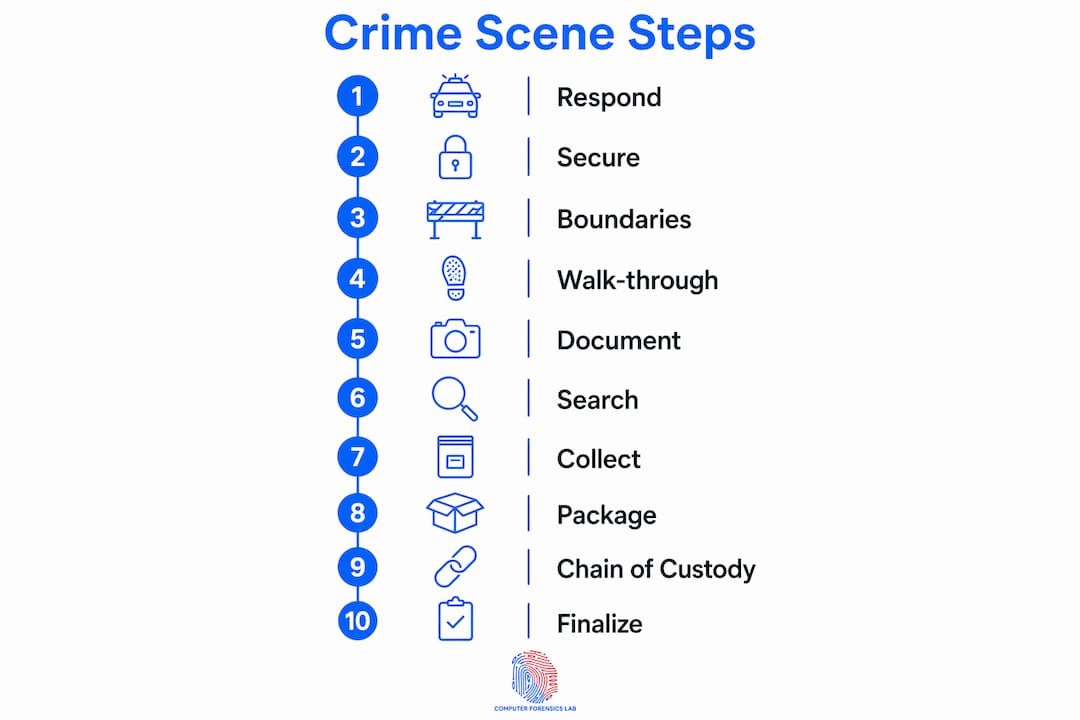
The 10 recognised steps are: respond and ensure safety, secure the scene, identify boundaries, conduct a walk-through, create a plan, document the scene, search for evidence, collect and package evidence, maintain chain of custody, and submit evidence for analysis and finalise the report. These stages are sequential for good reason. Skipping or reordering them introduces contamination risks, legal challenges, and gaps in the evidentiary record. Each step builds on the last, and the integrity of the entire investigation depends on discipline at every stage.
How do you secure and prepare a crime scene?
Safety supersedes evidence collection at every point in the initial response. Before any investigative work begins, responders must confirm that living persons receive medical attention and that scene hazards are neutralised. Those hazards include gas leaks, unstable structures, weapons, and biohazards such as fentanyl powder, which can be absorbed through skin contact.
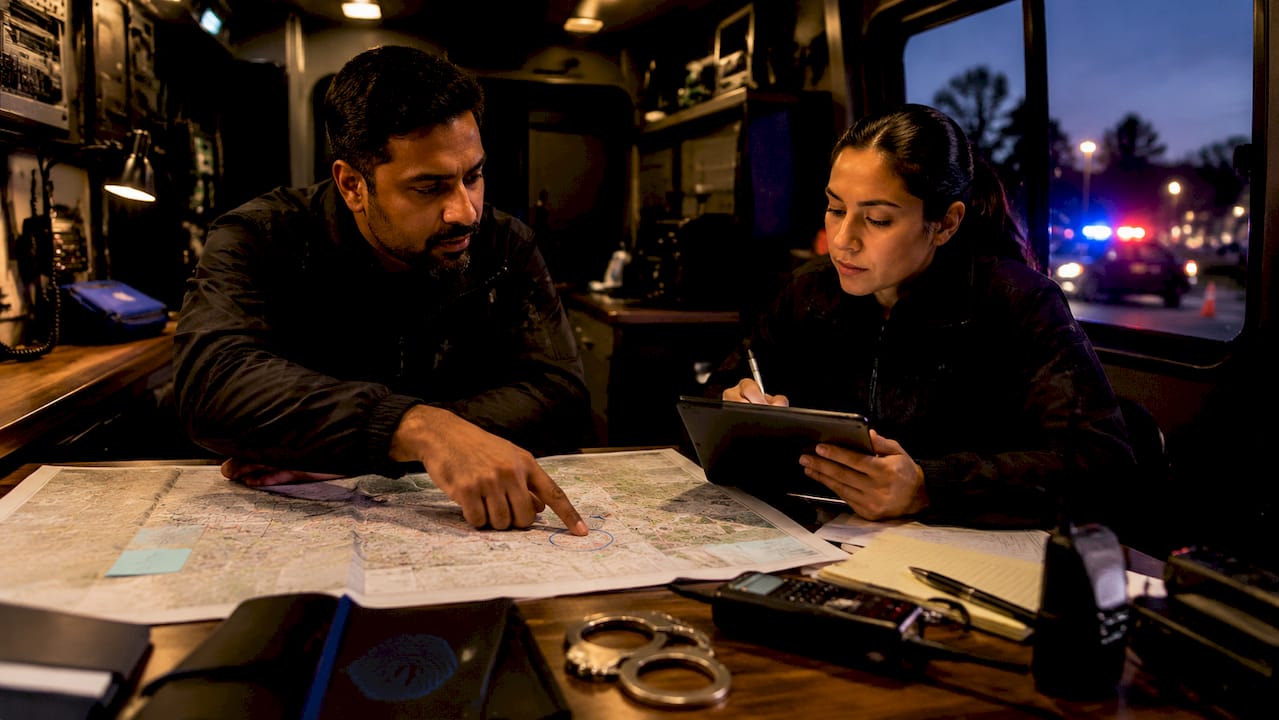
Once the scene is safe, establishing physical perimeters is the most critical action you can take. Scene security using inner and outer perimeters prevents unauthorised access and limits the risk of contamination from foot traffic, weather, or interference. The inner perimeter covers the immediate evidence area. The outer perimeter creates a buffer zone for command, media, and bystanders.
Access must be controlled through a single entry and exit point. Every person who enters or leaves the scene must be logged, with their name, role, time of entry, and time of departure recorded. A comprehensive entry-exit log is a legal safeguard. Any unexplained gap in that log can be used in court to challenge evidence admissibility.
Key actions at this stage include:
- Confirming all living persons are safe and medical assistance has been requested
- Establishing inner and outer perimeter boundaries using tape, barriers, or officers
- Designating a single controlled entry point with a signed access log
- Identifying and recording all potential hazards before personnel enter
- Issuing personal protective equipment to all scene personnel to prevent cross-contamination
Pro Tip: Assign one officer exclusively to manage the entry log. When the same person who is collecting evidence is also managing access, errors and omissions in the log become far more likely.
How is crime scene documentation conducted effectively?
Documentation is the phase that converts a physical scene into a legally admissible record. Multiple concurrent documentation methods are required to survive legal scrutiny. Notes alone are insufficient. Sketches alone are insufficient. Courts expect a layered record.
The four core documentation methods are:
- Written notes. Record dates, times, weather conditions, lighting, personnel present, and every observation made. Notes must be contemporaneous, meaning written at the time, not reconstructed later.
- Scale sketches and diagrams. Produce measured drawings of the scene showing the position of evidence, furniture, entry points, and distances. The Indiana State Police CSI Procedures Manual, effective January 2026, mandates that dimensions and spatial relationships are recorded before any item is moved.
- Photographs from multiple perspectives. Capture wide-angle shots to establish context, mid-range shots to show the relationship between items, and close-up shots to record individual pieces of evidence. Each photograph should include a scale marker and reference number.
- Video documentation. Video provides a continuous, contextual record that still photography cannot replicate. Walk the scene slowly and narrate what you observe. Video is treated as supplementary rather than a replacement for photographs.
Pro Tip: Photograph every surface again after evidence has been removed. Post-recovery photography proves the scene was fully examined and that nothing was concealed beneath a collected item. It is an expert practice that few investigators apply consistently, and it significantly strengthens the evidentiary record.
The walk-through that precedes documentation is a strategic evaluation, not a search. The initial walk-through is for hazard identification and planning movement paths to prevent cross-contamination. Investigators who begin collecting evidence during the walk-through routinely compromise the documentation that follows.
What search and evidence collection methods work best?
Searching a crime scene without a defined pattern produces gaps and overlaps. Structured search methodologies including grid, spiral, and lane patterns exist precisely to eliminate those errors. The grid pattern divides the scene into sections and assigns each to a specific investigator. The spiral pattern moves from the outer boundary inward, or from the centre outward. The lane pattern assigns parallel strips to individual searchers. Each method suits different scene types and sizes.

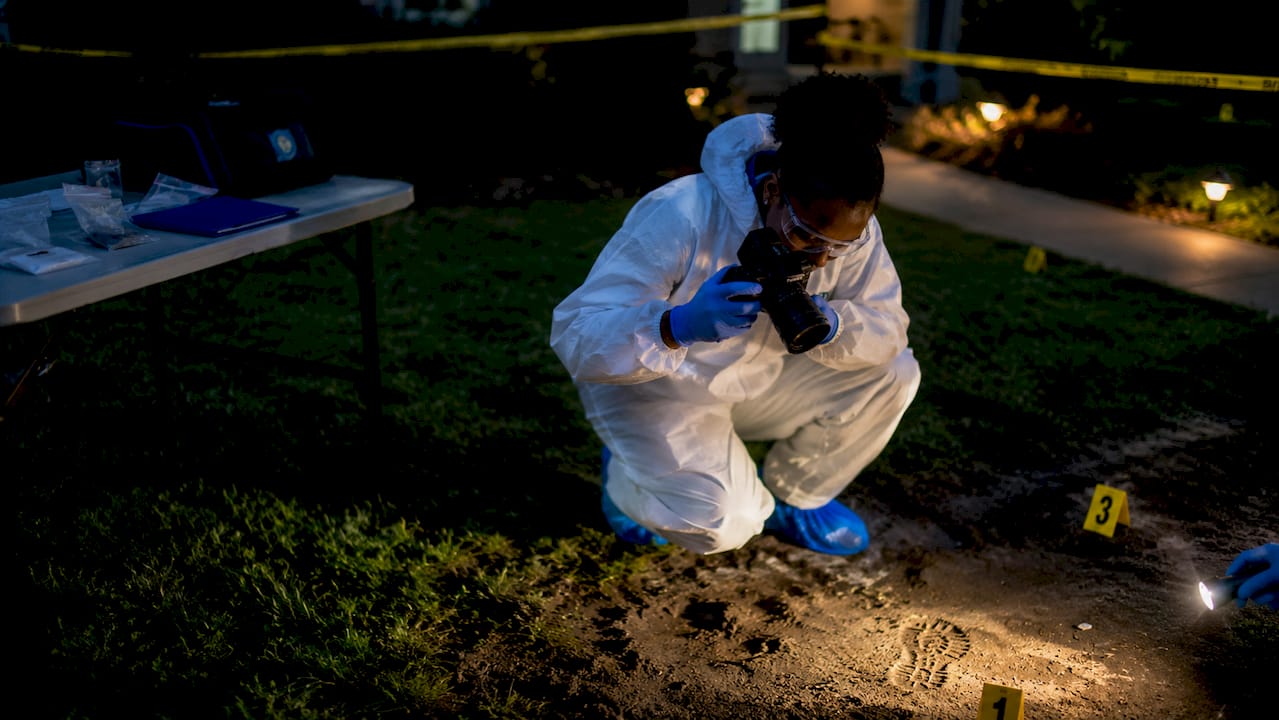
When evidence is located, it must be marked before it is touched. Numbered tent markers identify each item in place. Photographs are taken of the marked item before collection begins. Only then does an investigator collect the item using appropriate tools.
| Evidence type | Collection method | Packaging requirement |
|---|---|---|
| Biological (blood, tissue) | Sterile swabs or forceps | Paper bags to allow moisture escape |
| Trace (fibres, hair) | Tape lifts or tweezers | Sealed paper envelopes |
| Chemical (accelerants, drugs) | Airtight containers | Glass or metal tins |
| Digital devices | Faraday bags or powered-off isolation | Anti-static, tamper-evident packaging |
| Firearms | Trigger-locked, unloaded | Rigid cardboard boxes |
Packaging protocols are not optional. Biological evidence stored in plastic degrades rapidly due to moisture retention. Chemical evidence stored in plastic risks contamination from off-gassing. The packaging choice directly affects whether the evidence can be analysed at all.
The chain of custody is the legally critical backbone of the entire evidence handling process. Every item collected must have a written log recording who collected it, when, where, and every subsequent transfer of possession. Gaps in that record allow defence teams to argue tampering or contamination. Maintaining evidence integrity through chain of custody is as important as the collection itself.
Pro Tip: Seal and label every item at the point of collection, not back at the vehicle or the station. The moment an item leaves the scene unsealed, its chain of custody is already weakened.
How do investigators finalise a crime scene investigation?
The final stages of the investigation procedure are where many teams lose discipline. The pressure to clear a scene quickly leads to shortcuts that undermine the entire process.
- Conduct a secondary search. Walk the scene again after initial collection is complete. A second pass, ideally by a different investigator, catches items missed during the primary search. This step is not optional on serious crime scenes.
- Confirm evidence completeness. Cross-reference every numbered tent marker against the evidence log. Every marker placed must correspond to a collected, packaged, and logged item. Discrepancies must be resolved before the scene is released.
- Finalise the scene report. The report must include a full chronological account of all actions taken, all personnel present, all evidence collected, and all decisions made. The chain of custody documentation is attached as part of this report. Evidence preservation tips for legal forensics confirm that the report is the document courts rely on when the physical evidence is disputed.
- Submit evidence to the forensic laboratory. Each item is transferred under a formal submission form that continues the chain of custody record. The receiving laboratory signs for each item, and that signature becomes part of the permanent record.
- Release the scene. Only after all evidence is collected, logged, and submitted, and the scene report is complete, should the scene be formally released. Releasing a scene prematurely and then needing to re-enter creates serious legal complications.
Common pitfalls at this stage include incomplete tent marker reconciliation, unsigned transfer forms, and scene reports written days after the investigation rather than immediately. Each of these weaknesses has been used successfully in court to challenge evidence admissibility.
Key takeaways
A crime scene investigation follows a strict 10-step protocol where every stage, from securing the perimeter to submitting evidence, directly determines whether that evidence holds up in court.
| Point | Details |
|---|---|
| Safety comes first | Neutralise all hazards and attend to living persons before any evidence work begins. |
| Perimeter control is foundational | Inner and outer perimeters with a single logged entry point prevent contamination and legal challenges. |
| Documentation must be layered | Notes, sketches, photographs, and video together create the court-ready record no single method can provide alone. |
| Chain of custody is non-negotiable | Every transfer of evidence must be signed and logged; a single gap can render an item inadmissible. |
| Secondary searches prevent omissions | A second pass by a different investigator catches missed evidence before the scene is released. |
Why discipline matters more than technology in crime scene work
After years of working with forensic evidence at Computerforensicslab, the pattern I see most often is not a failure of equipment or expertise. It is a failure of patience. Investigators who rush the documentation phase because they are confident they know what happened create the most fragile cases. Courts do not care what you believed at the scene. They care what you recorded.
The walk-through is the step most frequently misused. I have reviewed cases where evidence was collected during the initial walk-through because an investigator spotted something obvious and grabbed it immediately. That single decision compromised the spatial record of the entire scene. The walk-through exists for planning, not collection. Treating it as anything else is a procedural shortcut with serious consequences.
Technology has changed what is possible in forensic analysis, particularly in digital evidence recovery. But the physical crime scene protocols described here have not changed in their fundamentals because they are built around legal requirements, not investigative convenience. The chain of custody log is still handwritten in many jurisdictions because a handwritten signature is harder to dispute than a digital entry. That is not backwardness. That is deliberate legal design.
The investigators who produce the most legally durable cases are not the fastest or the most technically sophisticated. They are the most methodical. Every marker placed, every photograph taken, every log entry completed is a small act of discipline that collectively determines whether justice is served.
— Computer
How Computerforensicslab supports crime scene investigations
Physical crime scenes increasingly intersect with digital evidence. Suspects communicate via encrypted apps, store data on cloud platforms, and leave digital footprints that physical investigation alone cannot recover. Computerforensicslab provides specialist digital forensics services that complement physical crime scene work, handling the recovery, analysis, and chain of custody documentation for digital evidence to the same rigorous standards described in this guide. Whether you are a legal professional, law enforcement officer, or private investigator, our London-based team can support your case with court-ready digital evidence collection and expert witness reporting. Contact Computerforensicslab to discuss how digital forensic analysis can strengthen your investigation.
FAQ
What are the 10 steps of crime scene investigation?
The 10 steps are: respond and ensure safety, secure the scene, identify boundaries, conduct a walk-through, create a plan, document the scene, search for evidence, collect and package evidence, maintain chain of custody, and submit evidence for analysis and finalise the report.
Why is chain of custody so important in crime scene work?
An unbroken chain of custody proves that evidence has not been tampered with or contaminated between collection and court presentation. Any gap in the written log gives defence teams grounds to challenge admissibility.
What is the purpose of the initial walk-through?
The initial walk-through is a planning and hazard identification exercise, not an evidence collection phase. It allows investigators to map movement paths and prioritise areas without disturbing the scene before documentation begins.
What search patterns do investigators use at a crime scene?
Grid, spiral, and lane patterns are the three standard methods. Each divides the scene systematically to prevent areas being searched twice or missed entirely, reducing the risk of overlooked evidence.
How should biological evidence be packaged at a crime scene?
Biological evidence must be packaged in paper bags or envelopes, never plastic. Plastic traps moisture, which accelerates degradation and can render biological samples unanalysable before they reach the laboratory.