

Selecting the right digital forensic company has become mission critical for UK legal professionals navigating increasingly complex digital evidence. With over 30,000 prosecutions collapsed between 2020 and 2024 due to evidence handling failures, the stakes have never been higher. You need forensic partners who combine technical excellence with legal rigour to support successful case outcomes. This comprehensive guide walks you through evaluating providers, comparing leading UK forensic companies, and matching specialist services to your specific litigation needs in 2026.
Table of Contents
- How To Evaluate Forensic Companies In The UK
- Top Forensic Companies Offering UK Digital Forensics Services
- Comparing Forensic Companies: Services, Accreditation And Reliability
- Choosing The Right Forensic Company For Your Case In 2026
- Expert Digital Forensic Services Tailored For UK Legal Professionals
Key takeaways
| Point | Details |
|---|---|
| Digital forensic backlogs threaten justice | Massive device backlogs and capacity shortages have contributed to thousands of prosecution collapses, making provider selection critical for case success. |
| ISO accreditation ensures reliability | ISO 17025 accreditation and proficiency testing participation reduce forensic errors by up to 30%, providing essential quality assurance. |
| UK forensic providers offer varied specialisms | Leading companies differ significantly in services, from mobile device analysis to cloud forensics and AI-related investigations. |
| Independent defence reviews gain importance | As AI and deepfakes challenge evidence integrity, independent forensic analysis becomes crucial for robust legal defence strategies. |
| Structured evaluation criteria enable confident choices | Assessing accreditations, turnaround times, specialist capabilities and legal experience helps you select the optimal forensic partner. |
How to evaluate forensic companies in the UK
When you’re selecting a digital forensic provider for litigation support, you must apply rigorous evaluation criteria to ensure evidence integrity and legal admissibility. The House of Lords has raised serious concerns about digital forensic capacity shortages impacting UK justice, making your choice of forensic partner more consequential than ever.
Start by verifying ISO 17025 accreditation, which demonstrates a laboratory’s technical competence and quality management systems. This international standard ensures forensic analysis meets stringent requirements for accuracy and reliability. Research shows that proficiency testing reduces errors by 30%, so prioritise providers who participate in regular external proficiency schemes.
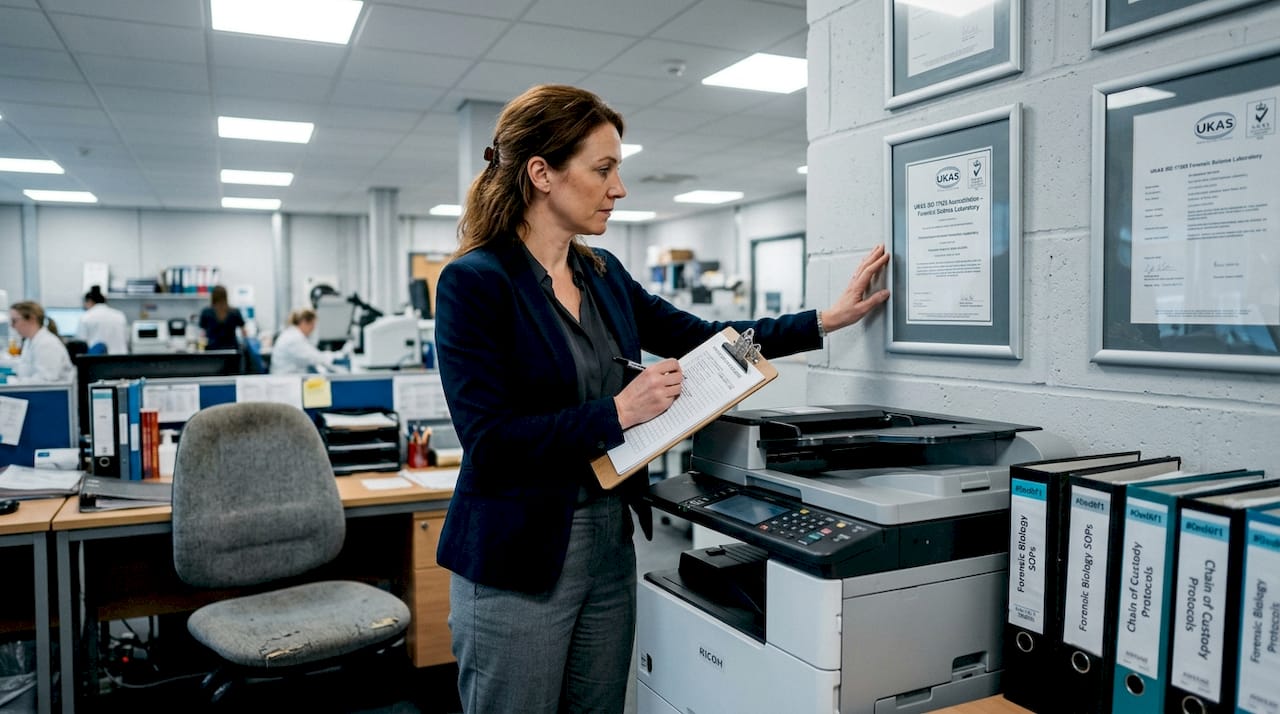
Examine the provider’s experience within the UK legal system specifically. You need forensic companies that understand UK compliance requirements, maintain proper chain of custody procedures, and can produce court-ready expert witness reports. Their analysts should be familiar with disclosure obligations, cross-examination protocols, and the evidential standards required by UK courts.
Consider specialist capabilities aligned with your case type:
- Mobile device forensics for smartphone and tablet evidence extraction
- Cloud forensics for SaaS platforms, email systems and remote storage
- Network forensics for cybercrime and data breach investigations
- AI and machine learning forensics for deepfake detection and algorithmic analysis
- Social media forensics for online harassment and fraud cases
Assess capacity and turnaround times carefully. Device backlogs plague many providers, potentially delaying your case progression. Ask about current workload, typical turnaround periods, and expedited service availability. Understanding the digital forensic process steps helps you evaluate whether quoted timeframes are realistic.
Pro Tip: Request case studies or references from similar legal matters to verify the provider’s track record in your specific area of law, whether criminal defence, civil litigation, or regulatory investigations.
Top forensic companies offering UK digital forensics services
Several established forensic companies serve UK legal professionals with varying specialisms and service models. Understanding their distinct strengths helps you identify the best match for your case requirements.
CACI operates one of the UK’s leading digital forensics laboratories, holding ISO 17025 accreditation for computer and mobile device forensics. The company has positioned itself to address police backlog issues by providing outsourced forensic services to law enforcement agencies. Their capabilities span device acquisition, data recovery, malware analysis, and expert witness testimony. CACI’s work with police forces gives them deep familiarity with criminal justice procedures and disclosure requirements.
Computer Forensics Lab delivers comprehensive digital evidence services specifically tailored for UK litigation contexts. Based in London, the company supports legal professionals, law enforcement, and private clients across diverse investigation types. Their service portfolio encompasses computing devices, mobile phones, social media platforms, and cloud data analysis. The firm emphasises maintaining chain of custody integrity and producing detailed expert witness reports that withstand courtroom scrutiny. Their involvement in media projects like Discovery+’s ‘999 Murder Calling’ demonstrates their credibility and public profile in forensic investigations.
Beyond these major players, you’ll find specialist providers focusing on emerging challenges:
- Cloud forensics specialists handling SaaS platforms, Microsoft 365, Google Workspace, and distributed storage systems
- Cybercrime investigation firms with penetration testing and threat intelligence capabilities
- Mobile forensics experts covering iOS, Android, and encrypted messaging applications
- Independent forensic consultants offering defence-side reviews and second opinions
The growing importance of independent defence reviews cannot be overstated. As prosecution evidence becomes more technically complex, particularly with AI-generated content and algorithmic decision-making, having forensic experts who can critically evaluate and challenge digital forensics in UK courts strengthens your defence strategy significantly.
When evaluating providers, consider their experience supporting both prosecution and defence cases. Firms exclusively serving one side may lack the balanced perspective needed for robust analysis. Look for UK digital forensic specialists who demonstrate technical excellence regardless of which party engages them.
Comparing forensic companies: services, accreditation and reliability
A structured comparison of leading UK forensic providers reveals significant differences in capabilities, accreditations, and service delivery that directly impact case outcomes. This analysis helps you weigh options against your specific legal requirements.
| Provider | ISO 17025 | Key Services | Turnaround | Strengths |
|---|---|---|---|---|
| CACI | Yes | Computer, mobile, malware analysis | Standard to expedited | Police partnerships, backlog capacity, criminal justice focus |
| Computer Forensics Lab | Accredited processes | Full digital evidence suite, expert witness, data recovery | Flexible | Litigation focus, chain of custody expertise, media credibility |
| Specialist cloud providers | Varies | SaaS platforms, Microsoft 365, distributed storage | Case dependent | Emerging technology expertise, cloud-native tools |
| Independent consultants | Individual credentials | Defence reviews, second opinions, technical challenges | Rapid for reviews | Objectivity, cross-examination experience, niche expertise |
The House of Lords has warned that digital forensic backlogs risk miscarriages of justice, making turnaround times a critical selection factor. Prosecution delays caused by forensic capacity shortages have led to case collapses, witness attrition, and justice denied for victims. When evaluating turnaround commitments, distinguish between routine cases and expedited services for time-sensitive matters.
Accreditation scope matters as much as its existence. Some providers hold ISO 17025 for specific forensic disciplines like mobile device analysis but not others. Verify that accreditation covers the exact services your case requires. Proficiency testing participation adds another reliability layer, with regular external assessments validating ongoing competence.
Specialist service availability increasingly determines provider suitability. As legal applications of digital forensics expand into AI, machine learning, and deepfake detection, you need forensic companies investing in cutting-edge capabilities. Ask about their tools for analysing algorithmic bias, detecting synthetic media, and investigating automated decision systems.
Consider the provider’s involvement in independent defence reviews. Forensic companies willing to critique prosecution evidence and provide balanced technical assessments demonstrate professional integrity. This objectivity proves invaluable when you need to challenge technical claims or identify investigative gaps. Understanding why securing digital evidence matters helps you evaluate whether providers prioritise evidence integrity over convenient conclusions.
Backlog management capabilities separate reliable providers from overwhelmed ones. With device volumes growing exponentially, forensic companies must demonstrate scalable processes, adequate staffing, and efficient case management systems. Ask specific questions about current caseloads, analyst availability, and contingency plans for capacity surges.
Choosing the right forensic company for your case in 2026
Matching forensic providers to your specific case needs requires strategic thinking about risk tolerance, technical complexity, budget constraints, and timeline pressures. These practical recommendations help you make informed decisions in 2026’s challenging forensic landscape.
-
Prioritise ISO 17025 accredited forensic companies for high-stakes criminal cases where evidence admissibility challenges are likely, as accreditation significantly reduces rejection risk and strengthens expert witness credibility under cross-examination.
-
Engage specialist providers for cybercrime investigations, AI-related evidence, or emerging technology cases where general forensic firms may lack current expertise in rapidly evolving technical domains.
-
Assess turnaround time criticality against your case timeline, recognising that over 30,000 prosecutions collapsed partly due to evidence delays, so factor realistic forensic timeframes into your litigation strategy.
-
Commission independent forensic reviews when defending against technical prosecution evidence, particularly in cases involving complex digital analysis, algorithmic systems, or AI-generated content where second opinions prove invaluable.
-
Budget appropriately for proficiency-tested analysts, secure data handling infrastructure, and comprehensive reporting, understanding that quality forensic services represent essential litigation investment rather than discretionary spending.
-
Verify the provider’s understanding of digital forensics’ role in litigation by discussing their approach to disclosure obligations, evidence preservation, and expert witness preparation specific to UK legal requirements.
Pro Tip: Establish relationships with multiple forensic providers across different specialisms before you need urgent services, as pre-existing partnerships enable faster response times and better service prioritisation when time-critical cases arise.
Consider the forensic company’s familiarity with your practice area. A provider experienced in employment tribunal matters brings different perspectives than one focused on serious organised crime. Their understanding of relevant legal tests, evidential thresholds, and common technical issues in your field adds significant value beyond pure technical capability.
Evaluate communication style and report quality through initial consultations. You need forensic analysts who can translate complex technical findings into clear, persuasive narratives for judges, juries, and opposing counsel. Request sample reports to assess whether their documentation meets your quality standards and courtroom needs.
Recognise that digital forensics’ role in law enforcement continues evolving rapidly. Providers investing in continuous professional development, emerging technology research, and industry engagement demonstrate commitment to maintaining cutting-edge capabilities. Ask about their training programmes, conference participation, and thought leadership contributions.
Expert digital forensic services tailored for UK legal professionals
Computer Forensics Lab delivers specialist digital forensics services designed specifically for UK litigation success. Our London-based team of experienced analysts combines technical excellence with deep understanding of legal requirements, providing ISO-accredited forensic analysis that withstands rigorous courtroom scrutiny. We examine computing devices, mobile phones, social media platforms, and cloud data to uncover critical evidence for criminal defence, civil litigation, and regulatory investigations. Our comprehensive capabilities include forensic data analysis, data recovery, malware examination, and expert witness testimony. We maintain meticulous chain of custody procedures and produce detailed reports that clearly communicate complex technical findings to legal audiences. Whether you need rapid device analysis for time-sensitive cases or independent reviews challenging prosecution evidence, our flexible service delivery adapts to your specific requirements. Discover how digital forensics data can strengthen your case strategy by contacting our team for a confidential consultation.
FAQ
What qualifications should UK forensic companies have?
ISO 17025 accreditation remains the gold standard for UK forensic laboratories, demonstrating technical competence, quality management systems, and adherence to international standards. Beyond accreditation, look for proficiency testing participation, relevant academic qualifications in computer science or digital forensics, and professional certifications like EnCE or GCFA. Membership in professional bodies such as the Chartered Society of Forensic Sciences indicates commitment to ethical standards and continuing professional development. Verify that analysts have UK digital forensics qualifications and understand legal compliance requirements specific to British courts.
How do forensic companies help prevent case collapses?
Forensic companies prevent case collapses by providing accredited analysis that maintains evidence integrity throughout investigation and prosecution phases. Their rapid turnaround capabilities address the capacity shortages that have contributed to over 30,000 collapsed prosecutions in recent years. Proper chain of custody management, proficiency-tested methodologies, and comprehensive documentation reduce error risks that lead to evidence challenges. Independent forensic reviews identify potential weaknesses before trial, allowing legal teams to address issues proactively. Understanding digital forensics in UK courts helps providers deliver analysis that meets judicial expectations and withstands cross-examination.
What challenges do forensic companies face with AI and deepfake evidence?
Emerging AI technologies and deepfakes significantly increase forensic complexity by enabling sophisticated content manipulation that traditional analysis methods struggle to detect reliably. AI and deepfakes challenge evidence reliability but simultaneously provide powerful tools for detecting synthetic media and algorithmic manipulation. Leading forensic companies invest in machine learning systems that identify deepfake artefacts, analyse metadata inconsistencies, and trace content provenance. However, the rapid evolution of generative AI means forensic capabilities must continuously adapt to stay ahead of increasingly sophisticated manipulation techniques. This arms race requires ongoing research investment and specialist expertise in AI challenges within digital forensics that many traditional providers lack.
How long does digital forensic analysis typically take?
Digital forensic analysis timelines vary dramatically based on case complexity, device types, data volumes, and provider capacity. Simple mobile phone extractions may complete within days, whilst complex multi-device investigations involving encrypted data, cloud services, or malware analysis can require weeks or months. Current industry backlogs mean some providers quote turnaround times of several months for routine cases. Expedited services typically cost significantly more but can deliver critical analysis within days when case urgency justifies premium pricing. Always discuss realistic timeframes during initial consultations and factor forensic analysis duration into your overall litigation timeline to avoid delays that might jeopardise case outcomes.