Expert witness testimony is the sworn opinion or exposition of specialised knowledge a qualified professional gives to help a judge or jury understand technical evidence or resolve a disputed fact. Unlike an ordinary witness, who can only describe what they directly saw or heard, an expert may offer opinion drawn from training and experience. Their overriding obligation runs to the court itself, not to whichever side pays their fee.
TL;DR:
- Experts must clearly disclose all factual assumptions, conflicts of interest, and scope limits to ensure their opinions remain impartial and credible.
- Digital forensics evidence requires meticulous documentation of acquisition methods, chain-of-custody logs, and reproducible procedures to withstand cross-examination.
- Courts judge expert reliability based on relevance, recognized methodology, peer review, and error rate, with well-documented methods outperforming impressive qualifications.
- In cross-border cases, jurisdictional differences can significantly affect discovery, judge screening, and the use of joint experts, demanding careful planning.
- A robust expert report should transparently show its working, include supporting data, and avoid unstated assumptions to prevent exclusion on reliability grounds.
Table of Contents
- Who counts as an expert and what does an expert witness do?
- What duty does an expert witness owe the court, and how do they stay impartial?
- Consulting experts, testifying experts and single joint experts: what is the difference?
- How do you instruct an expert, and what should the report contain?
- How do courts decide whether expert evidence is reliable enough to admit?
- What should an expert expect during disclosure and cross-examination?
- How do you choose an expert who will hold up under scrutiny?
- What does a well-structured expert report actually look like?
- How is expert testimony handled in digital forensics cases?
- How does expert witness testimony practice differ between jurisdictions?
- What role does expert testimony play in civil, criminal and family cases?
- A practising perspective on what people misunderstand about expert testimony
- How Computer Forensics Lab supports expert witness instructions
- Sources
- FAQ
Who counts as an expert and what does an expert witness do?
Courts do not test expertise by job title or academic letters alone. The Wex legal definition frames it as specialised knowledge, whether gained through formal education, professional training, or accumulated hands-on experience, that goes beyond what an ordinary juror would know. A self-taught locksmith with thirty years on the job can qualify just as readily as a professor with a doctorate, provided the knowledge genuinely assists the court.
The role itself splits into three practical functions:
- Exposition — explaining a technical field in plain terms, such as how ransomware encrypts files.
- Opinion — drawing a specific conclusion from the facts, such as whether a signature is forged.
- Criterion provision — setting out the standards the court itself can use to test that conclusion, rather than simply asserting it.
Common fields include forensic pathology, structural engineering, forensic accounting, psychiatry, and digital forensics. Each brings a different technical vocabulary, but the underlying duty and the report structure barely change from one discipline to the next.
What duty does an expert witness owe the court, and how do they stay impartial?
An expert’s paramount duty runs to the court, overriding any obligation to the party who instructed and paid them. CPS prosecution guidance states this plainly: independence is not optional, and any material fact that weakens the expert’s own opinion must still be disclosed.
That duty translates into concrete habits rather than a vague promise of fairness:
- State every factual assumption the opinion rests on, so the court can test it if the facts turn out differently.
- Disclose any conflict of interest, prior relationship with a party, or financial stake in the outcome.
- Confine opinions strictly to the expert’s own field. Straying outside it, sometimes called scope creep, is one of the fastest ways an opinion loses credibility.
- Revise or qualify a conclusion promptly if new evidence emerges, rather than defending an outdated position.
The ICCA expert witness guidance is unambiguous that experts must not act as advocates. A report that argues for one side’s case, rather than setting out an objective opinion, invites exactly the kind of challenge that can see it excluded.
Pro Tip: If you are instructing an expert, ask early how they intend to record their assumptions. An expert who cannot point to a written assumptions list at the outset will struggle to defend their opinion months later, when memories have faded and the other side’s barrister starts asking pointed questions.
Consulting experts, testifying experts and single joint experts: what is the difference?
Not every expert who advises a case ever sets foot in a courtroom, and the distinction matters enormously for privilege.
- Consulting experts work behind the scenes, advising the legal team on strategy, likely weaknesses, or technical feasibility. Their advice is usually privileged and stays confidential, precisely because they never testify.
- Testifying experts are formally disclosed to the opposing side. Once disclosed, their report, underlying data, and methodology generally become discoverable, as Cornell’s definition of an expert witness confirms.
- Single joint experts are appointed by agreement between both parties, or ordered by the court, typically in lower-value civil claims or family proceedings where two competing experts would be disproportionate. Some jurisdictions also use “hot tubbing,” where experts give concurrent evidence and answer questions side by side.
A dispute involving contested medical causation, a suspected data breach, or a construction defect claim will typically need at least one testifying expert once litigation is underway.
How do you instruct an expert, and what should the report contain?
A letter of instruction should set out the specific questions the expert is being asked to answer, the documents and materials being supplied, and any relevant background facts already agreed between the parties. Vague instructions produce vague reports, and vague reports get picked apart in cross-examination.
The report itself follows a fairly consistent structure across jurisdictions. Federal Court expert witness guidelines list the elements courts expect to see:
- The expert’s qualifications and relevant experience.
- Every document, sample, or dataset considered in reaching the opinion.
- The methods applied and the reasons underpinning each conclusion.
- Any limitations, caveats, or areas of uncertainty in the analysis.
- A signed declaration confirming the opinion is independent and complete.
Supporting annexes matter just as much as the narrative. Raw data, photographs, calculations, and, in digital cases, chain-of-custody logs should all be attached so the opposing expert, and the court, can retrace every step. A report that asserts a conclusion without showing the working is far easier to attack than one that lays out its evidence transparently, a point covered in more depth in guidance on creating expert witness reports for digital evidence.
How do courts decide whether expert evidence is reliable enough to admit?
Courts act as gatekeepers before a jury ever hears an expert’s opinion, screening out testimony that sounds authoritative but rests on shaky ground. In the United States, Federal Rule of Evidence 702 requires that expert testimony be based on sufficient facts or data, arise from reliable principles and methods, and be reliably applied to the facts of the case. This is the modern descendant of the Daubert standard, which replaced the older Frye “general acceptance” test in federal courts. UK proceedings apply a comparable filter through Part 35 of the Civil Procedure Rules and related practice directions, which govern the form, content, and permissible scope of expert evidence in civil claims.
Judges typically weigh:
- Relevance — does the opinion actually help resolve a fact in dispute?
- Methodology — was a recognised, testable method used, rather than an untested or personal technique?
- Peer review — has the method been published or scrutinised by others in the field?
- Error rate — is there a known, quantifiable rate at which the method produces mistakes?
Cornell’s expert witness entry notes that courts weigh exactly these factors, and an opinion that fails on methodology alone is routinely excluded before trial, regardless of the expert’s paper qualifications. That is why a well-documented, reproducible process consistently outperforms an impressive CV.
What should an expert expect during disclosure and cross-examination?
Once an expert is disclosed as a testifying witness, their work becomes subject to formal scrutiny long before they ever sit in a witness box.
- Pre-trial disclosure typically requires the expert to hand over their report, working notes, and any data or drafts that informed the final opinion.
- Depositions, common in US litigation and increasingly used elsewhere, let opposing counsel question the expert under oath about methodology, assumptions, and any prior inconsistent statements.
- Cross-examination at trial probes the same ground again, often focusing on gaps between the raw data and the stated conclusion, or on any earlier reports where the expert reached a different view.
The American Bar Association’s guidance on expert witnesses makes a useful point: experts who kept a transparent, versioned record of their analysis, including rejected hypotheses, survive aggressive questioning far better than those who present only a polished final answer.
Pro Tip: Prepare a small set of visual demonstratives, a diagram, timeline, or annotated screenshot, before trial. Juries and judges retain a clear image far longer than a paragraph of technical description, and a good demonstrative also gives you something concrete to point to under cross-examination rather than relying on memory alone.
How do you choose an expert who will hold up under scrutiny?
Selecting the wrong expert can sink an otherwise strong case, so the vetting process deserves as much attention as the legal argument itself.
- Confirm qualifications match the exact technical question at issue, not just the general field.
- Ask for examples of prior case experience, including how their opinions fared under cross-examination.
- Check for independence: previous work exclusively for one type of party, or an undisclosed financial interest, invites challenge.
- Establish fee arrangements and availability up front. An expert who cannot commit to trial dates is a liability, however strong their opinion.
- Test their ability to explain technical findings in plain language. An expert who cannot make a jury understand the evidence is of limited use, however sound the underlying analysis.
Reputation among instructing solicitors, rather than marketing claims, remains one of the most reliable signals of an expert’s real-world performance.
What does a well-structured expert report actually look like?
A clear, defensible report tends to follow a predictable shape rather than a rigid legal template: scope of instruction, background facts, methodology, findings, opinion, limitations, and a signed declaration. Chain-of-custody annexes and supporting exhibits sit at the back, referenced by number throughout the narrative so every claim can be traced to its source.
Certain warning signs tend to recur in weaker reports, and readers reviewing one should watch for them:
- An argumentative tone that reads more like a closing speech than a neutral opinion.
- Missing or unexplained data gaps between the evidence gathered and the conclusion reached.
- Assumptions left unstated, so the reader cannot tell what the opinion actually depends on.
A report that cannot show its working, that states a conclusion without the criteria to test it, is not expert evidence. It is simply an assertion wearing a lab coat.
That distinction, between showing the method and merely stating a result, is often what separates admissible opinion from evidence a judge strikes out before trial.
How is expert testimony handled in digital forensics cases?
Digital evidence brings its own version of the same rules, sharpened by how easily electronic data can be altered, misread, or lost, making secure document handling crucial for evidence custodians. Acquisition method, chain of custody, and reproducibility all need to be documented at the point of collection, not reconstructed afterwards from memory.
- Acquisition records show exactly how data was extracted from a device, phone, or cloud account, and with what tools.
- Chain-of-custody logs track every hand the evidence passed through, from seizure to courtroom.
- Reproducible methods mean another qualified examiner could repeat the same steps and reach the same result.
As with other fields, a forensic consultant advising privately differs from a testifying expert who must disclose methods, data, and reasoning once the case reaches litigation, a distinction explored further in the role of expert witnesses in digital forensics. Transparency matters more here than almost anywhere else: a deleted-file recovery or a metadata analysis that cannot be independently verified rarely survives serious cross-examination, however competent the original work.
How does expert witness testimony practice differ between jurisdictions?
The underlying purpose of expert testimony, helping a court understand something it could not grasp unaided, stays constant worldwide, but the procedural rules vary considerably. US federal courts apply Rule 702 and the Daubert framework, placing the trial judge firmly in the gatekeeper role before a jury hears a word of expert opinion. England and Wales rely on Part 35 of the Civil Procedure Rules, which imposes a duty to the court explicitly in the rule text itself, alongside detailed practice directions on report format and permission requirements.
Scotland operates under separate court rules, with guidance from the Crown Office and Procurator Fiscal Service (COPFS) shaping how expert evidence is handled in criminal proceedings north of the border. Australia and New Zealand have gone further toward standardisation through the Harmonised Expert Witness Code, adopted across multiple courts specifically to reduce partiality and align report content between jurisdictions that might otherwise diverge.

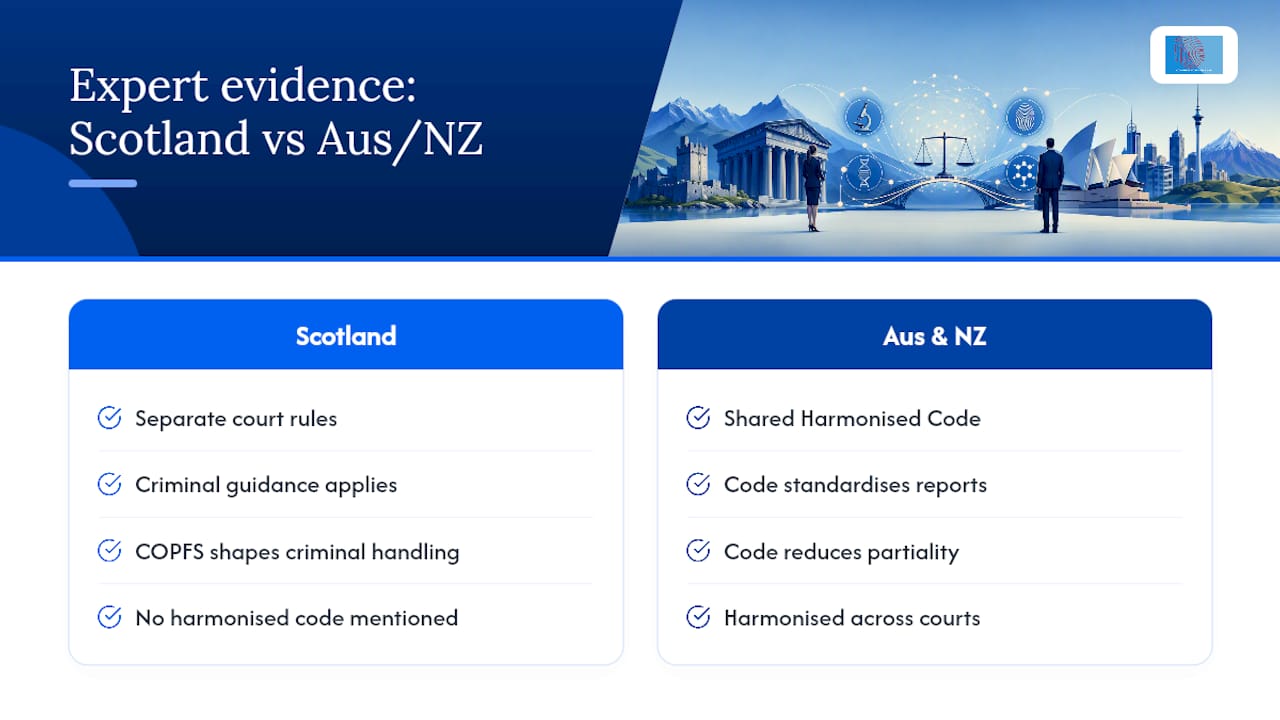
Some practical differences matter more than others to anyone actually involved in a case. Discovery obligations, for example, differ sharply: US depositions expose an expert to extensive pre-trial questioning that has no direct equivalent in many other systems. Single joint experts appear far more often in English family and lower-value civil claims than in US litigation, where each side almost always retains its own. Anyone instructing an expert across borders, in a cross-border fraud investigation or an international commercial dispute, needs to check the local admissibility rule before assuming familiar habits will transfer.
What role does expert testimony play in civil, criminal and family cases?
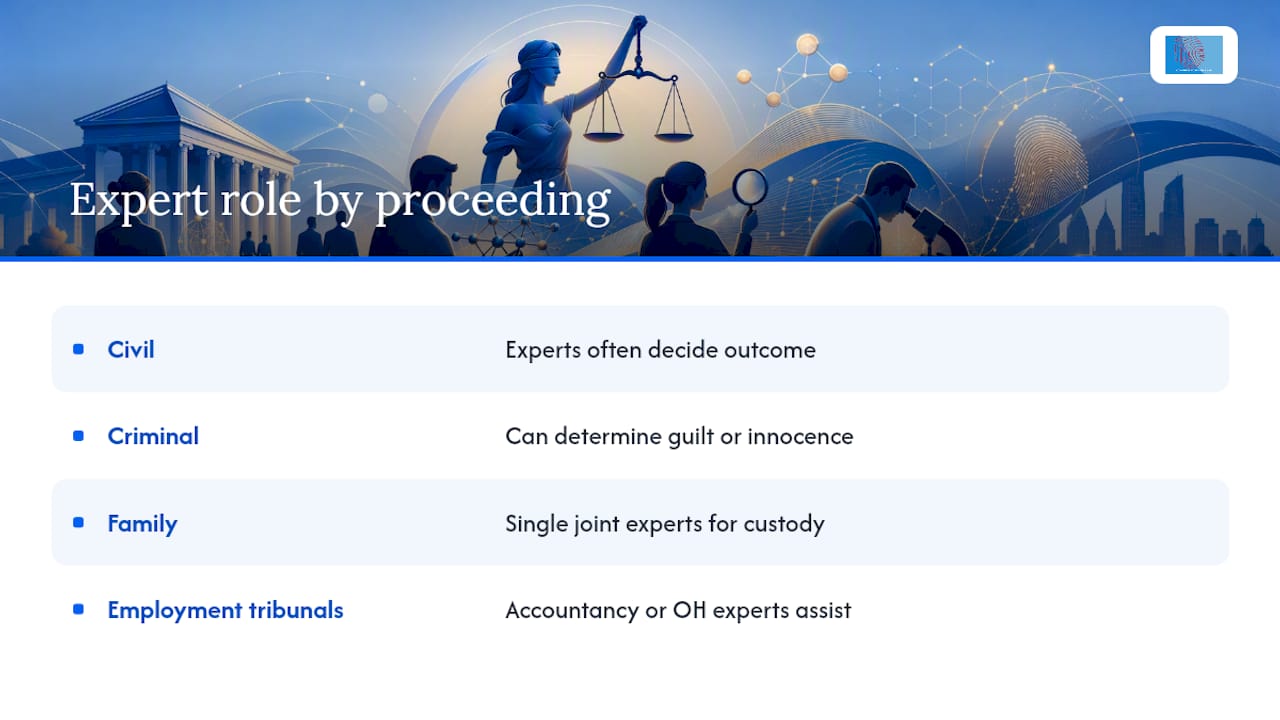
The weight expert evidence carries shifts considerably depending on the type of proceeding. In civil litigation, experts frequently decide the outcome outright: a construction defect claim, a medical negligence case, or a commercial dispute over lost profits usually turns on competing expert opinions about causation or valuation rather than on disputed facts of what happened.
Criminal proceedings raise the stakes differently. Forensic pathology, ballistics, and increasingly digital forensics can determine guilt or innocence, which is exactly why the reliability standards discussed earlier, peer review, error rates, tested methodology, matter so intensely in this context. A flawed forensic opinion in a criminal trial does not just cost money; it risks a wrongful conviction or a guilty person walking free.
Family proceedings lean more heavily on single joint experts, particularly for psychological assessments in custody disputes or valuations in divorce settlements, where the adversarial model of two competing experts would be disproportionate to what is at stake for the children involved. Employment tribunals and regulatory hearings sit somewhere between these extremes, often relying on accountancy or occupational health experts to establish facts a lay panel could not assess unaided.
Across every one of these settings, the expert’s function stays the same: translate specialised knowledge into something a non-specialist decision-maker can actually rely on.
A practising perspective on what people misunderstand about expert testimony
Most disputes about expert evidence are not really disputes about the conclusion. They are disputes about whether the method behind it can be shown, step by step, to someone who was not in the room when the analysis happened. Lay readers often assume a strong opinion needs a strong personality behind it. Courts reward the opposite: an expert who documents assumptions, keeps a version history, and states plainly where their certainty runs out.
If you are facing a dispute involving deleted files, contested metadata, or a suspected breach, get a forensic specialist involved before evidence is altered by ordinary use, not after.
— Computer
How Computer Forensics Lab supports expert witness instructions
Where a case turns on a mobile phone, a cloud account, or a corporate network, expert digital forensics services provide the practical route to admissible digital evidence, rather than leaving a legal team to interpret raw data alone. Services may cover expert report writing, court attendance, chain-of-custody management, and full digital evidence analysis, built around common disclosure and reliability standards discussed throughout this article.
Initial engagement typically starts with an instruction call to establish scope, the devices or accounts involved, and the specific questions the report needs to answer. From there, acquisition and analysis proceed under documented, reproducible methods so resulting reports can withstand cross-examination rather than collapsing under it. Anyone instructing an expert for the first time can review the full digital forensics services offering, then get in touch to discuss the specifics of a live case and receive a scoped quote.
This article is general information, not a substitute for advice from a qualified lawyer. Consult a qualified legal professional about your own circumstances before acting on anything here.
Sources
- Expert testimony — Wex (Legal Information Institute)
- Expert evidence — CPS prosecution guidance
- Federal Court expert witness guidelines (Annexure B)
- ICCA expert witness guidance
FAQ
What is expert witness testimony?
It is sworn opinion or exposition of specialised knowledge, given by a qualified professional to help a judge or jury understand technical evidence or resolve a disputed fact, as defined by Cornell’s Legal Information Institute.
What is the difference between expert testimony and lay witness evidence?
A lay witness can only describe what they directly observed, while an expert may offer opinion and interpretation drawn from specialised training or experience, subject to the court’s reliability screening.
Can you give an example of expert testimony?
A forensic accountant explaining how funds moved through shell companies in a fraud trial, or a digital forensics expert detailing how deleted files were recovered from a seized laptop, are both common real-world examples.
What counts as expert testimony under the rules of evidence?
Testimony counts as expert evidence when it rests on specialised knowledge beyond an ordinary person’s understanding, is based on sufficient facts or data, and applies reliable methods, per the standard set out in Rule 702.
What should a UK expert witness statement typically include?
A compliant UK report sets out the expert’s qualifications, the materials considered, the methodology used, reasoned conclusions, stated limitations, and a signed declaration of independence, structured around Part 35 requirements.