

TL;DR:
- Online investigations systematically collect and analyze digital evidence to uncover facts for legal or private inquiries. Proper procedures, proper authorization, and thorough documentation are essential to ensure evidence admissibility and investigative accuracy.
Online investigations are the systematic process of collecting, preserving, and analysing digital evidence to uncover facts in legal or private enquiries. The standard industry term is “digital forensic investigation,” and both terms describe the same disciplined methodology. Integrated digital investigation platforms improve case efficiency by up to 5.8x and reduce costs by 33% compared to siloed tools. That gap exists because structured workflows, proper evidence hashing using SHA-256, and compliance with standards set by the National Institute of Standards and Technology (NIST) separate admissible findings from inadmissible ones. Whether you are a solicitor building a case or a private individual tracing fraud, the methodology is the same.
What tools and prerequisites do online investigations require?
Effective digital investigations begin before a single file is copied. Legal authorisation comes first. Without a preservation order, court order, or documented client consent, any evidence you collect risks being excluded at tribunal.
Once authorisation is confirmed, the core toolkit falls into four categories:
- Forensic imaging software: Creates bit-for-bit copies of storage media. SHA-256 hashing verifies that the copy is identical to the original, satisfying forensic defensibility requirements.
- SIEM platforms: Security Information and Event Management tools aggregate log data across networks to surface anomalies and attack timelines.
- Network forensics tools: Capture and replay packet data to reconstruct communications, file transfers, and intrusion paths.
- Link analysis software: Tools such as Maltego, i2 Analyst’s Notebook, and Gephi map relationships among IPs, domains, and accounts to generate investigative leads.
| Tool category | Primary role |
|---|---|
| Forensic imaging | Creates verified, tamper-evident copies of storage media |
| SIEM | Aggregates and correlates log events across systems |
| Network forensics | Captures and reconstructs network traffic |
| Link analysis | Maps entity relationships across accounts, IPs, and domains |
| Mobile extraction | Recovers data from smartphones including deleted messages |
Chain of custody documentation sits alongside every tool. Every handling instance must be logged with times, actors, tools used, and cryptographic hashes. A single gap in that record can reduce the weight of evidence at tribunal.

Pro Tip: Before imaging any device, write-protect it using a hardware write blocker. This prevents the operating system from altering timestamps or metadata during acquisition.
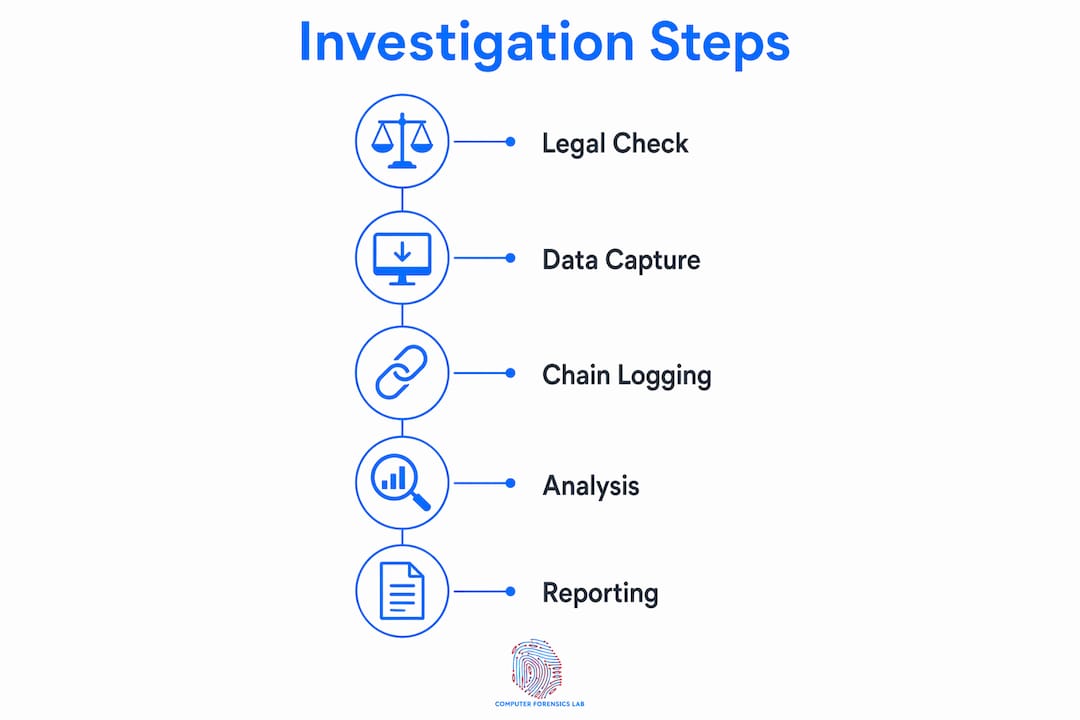

How to conduct online investigations step by step
A structured workflow prevents the two most common failures: premature collection and delayed preservation. The following sequence applies to both cybercrime cases and private digital enquiries.
-
Intake and triage. A triage framework scores urgency, harm category, evidence volatility, and scale. This determines what to preserve first and whether law enforcement notification is required.
-
Legal authorisation. Confirm the legal basis for collection. This may be a court order, a data subject access request, or written client consent. Document the authorisation before touching any system.
-
Volatile data capture. RAM, active network connections, and running processes disappear the moment a device powers down. Volatile evidence contains decrypted content and active session tokens that are irretrievable after shutdown. Capture this first.
-
Forensic imaging. Create a bit-for-bit image of storage media. Hash the image with SHA-256 immediately. Store the original and work exclusively from the verified copy.
-
Live vs dead-box acquisition. Live acquisition is mandatory for full-disk encrypted systems where decryption keys exist only in memory. Dead-box acquisition is simpler but loses all volatile data. Choose based on the device state and encryption status.
-
Timeline reconstruction. Normalise timestamps across all data sources. Correct for clock skew, where a device’s internal clock differs from real time. A one-hour clock error can collapse an alibi or create a false one.
-
Analysis. Apply link analysis, keyword searches, and anomaly detection to the verified copies. Document every tool version, input hash, and command used.
-
Reporting. Produce a structured report that a non-technical judge or jury can follow. Include methodology, findings, limitations, and a clear chain of custody record.
Pro Tip: Timestamp normalisation is frequently overlooked. Always record the device’s reported time against a trusted time source at the point of acquisition. This single step prevents timeline disputes in court.
The chain of custody record must accompany every piece of evidence from capture to courtroom. Any break in that record invites a challenge to admissibility.
What mistakes undermine online investigations?
The most damaging errors in digital investigations are procedural, not technical. They occur before analysis begins.
- Collecting without legal basis. Jumping to data collection without authorisation risks evidence contamination and legal challenge. A triage framework prevents premature collection by establishing legal and technical prerequisites before any acquisition starts.
- Delaying volatile data capture. Waiting to image a live system while seeking approval destroys RAM contents, active connections, and decrypted files. These are gone permanently once the device shuts down.
- Gaps in chain of custody. Failing to log a single transfer, tool use, or storage handover creates a gap that opposing counsel will exploit. Every action must be recorded with a timestamp and actor name.
- Ignoring full-disk encryption. Imaging a powered-down encrypted device without first capturing the decryption keys from memory produces an unreadable image. Recognise encryption status during triage, not after.
- Clock skew errors. Failing to record and correct for device clock inaccuracies corrupts the entire timeline reconstruction.
“Documentation is integral to the forensic method, not an afterthought. Every analytic step, including tool versions, input hashes, and commands run, must be recorded to satisfy standards such as the UK ACPO principles and enable reproducibility in court.”
Pro Tip: Create a pre-investigation checklist that includes legal authorisation confirmation, write blocker availability, hash verification steps, and chain of custody log initialisation. Run it before touching any device.
The ACPO (Association of Chief Police Officers) Good Practice Guide for Digital Evidence sets the UK standard for forensic defensibility. Private investigators and legal professionals should apply the same principles, even outside law enforcement contexts.
How to interpret and analyse digital evidence effectively
Raw data does not speak for itself. Analysis transforms collected artefacts into findings that support or refute a hypothesis.
- Link analysis. Tools like Maltego aggregate public and commercial data to map connections between IP addresses, email accounts, social media profiles, and domains. This technique is central to tracing fraud networks and identifying anonymous actors in cyber sleuthing work.
- Hypothesis testing. Form a specific hypothesis before analysis begins. “The suspect accessed the server between 02:00 and 04:00 on 14 march” is testable. Vague theories produce vague findings. Cross-validate every finding across at least two independent data sources.
- Authenticity verification. Compare file metadata, hash values, and creation timestamps against known-good baselines. Altered metadata is a common indicator of evidence tampering.
- Malware and identity abuse analysis. Examine process trees, registry entries, and network beaconing patterns to identify malicious software. Identity abuse cases require correlating login events, geolocation data, and device fingerprints across platforms.
- Reproducible documentation. Documenting each analytic step, including tool versions, input hashes, and commands, enables a second examiner to reproduce the findings independently. This satisfies both the UK ACPO principles and the US Daubert standard for expert testimony.
Pro Tip: Never form conclusions from a single data source. A login event in a server log only becomes evidence when corroborated by network traffic, device geolocation, or account activity records.
For legal professionals, the output of analysis must support expert witness reports that are clear, reproducible, and defensible under cross-examination. The analytical record is the foundation of that report.
Key takeaways
Effective online investigations depend on legal authorisation, volatile data capture, and rigorous chain of custody documentation from the first moment of engagement.
| Point | Details |
|---|---|
| Legal authorisation first | Collect nothing without a court order, preservation notice, or documented client consent. |
| Capture volatile data early | RAM and active connections are lost on shutdown; acquire them before imaging storage media. |
| Hash every image | SHA-256 verification confirms evidence integrity and satisfies forensic defensibility requirements. |
| Document every step | Tool versions, input hashes, and commands must be recorded to meet UK ACPO principles. |
| Cross-validate findings | Corroborate every conclusion across at least two independent data sources before reporting. |
What I have learned from years of digital forensic work
The single most underestimated phase of any investigation is the first ten minutes. Practitioners who rush past triage to begin imaging often destroy the most valuable evidence before they have even started. Volatile memory holds decrypted files, active session tokens, and live network connections that no imaging tool can recover once the device is powered down. That window is narrow and it does not reopen.
The live versus dead-box acquisition decision is where experience separates good investigators from great ones. Dead-box acquisition is tidier and less risky to the evidence record. But on a fully encrypted device, it produces nothing usable. Recognising encryption status at triage, not after imaging, is a skill built through repetition and continuous training.
AI-powered analysis tools are changing what is possible in digital investigations. Platforms that integrate SIEM data, link analysis, and timeline reconstruction into a single workflow reduce case resolution times dramatically. The efficiency gains are real. But AI does not replace the investigator’s judgement on legal authorisation, acquisition method, or the credibility of a finding. It accelerates the analytical phase; it does not govern the forensic method.
The legal standards that govern admissibility, particularly the UK ACPO principles, are not bureaucratic obstacles. They are the framework that makes findings credible in court. Investigators who treat documentation as a burden rather than a discipline produce findings that collapse under cross-examination. The methodology is the evidence.
— Computer
How Computerforensicslab supports your investigation
Computerforensicslab provides end-to-end digital forensic investigations for legal professionals and private clients across the UK. Services cover evidence capture, forensic imaging, chain of custody management, malware analysis, and social media examination. Every case produces a structured report suitable for court, with full methodology documentation and reproducible findings. For cases requiring formal legal testimony, Computerforensicslab prepares expert witness reports that meet UK court standards. Whether you are dealing with fraud, data theft, employee misconduct, or a complex cybercrime matter, professional forensic services provide the rigour that self-conducted enquiries cannot. Contact Computerforensicslab to discuss your case.
FAQ
What is the difference between online investigations and digital forensics?
Online investigations describe the broader process of gathering and analysing internet-sourced evidence. Digital forensics is the formal discipline that governs how that evidence is collected, preserved, and presented in court to meet legal admissibility standards.
How do I preserve evidence before a forensic examiner arrives?
Do not power down the device, as this destroys volatile data. Photograph the screen, note the time against a trusted clock, and restrict access to the device until a qualified examiner can perform a live acquisition.
What legal authority do I need to conduct a digital investigation?
In the UK, private investigations require documented client consent or a court-issued preservation order. Law enforcement requires a warrant or production order. Collecting data without legal basis risks evidence exclusion and potential criminal liability.
How does chain of custody affect court admissibility?
A complete chain of custody log records every person who handled the evidence, every tool used, and every transfer made, with timestamps and hash values. A single undocumented gap gives opposing counsel grounds to challenge the integrity of the entire evidence set.
Can deleted data be recovered during an online investigation?
Deleted files often remain recoverable from unallocated disk space until overwritten. Forensic imaging captures the full disk, including deleted artefacts, which trained examiners can reconstruct using specialist recovery techniques.