Google-backed Android data can be forensically recovered for evidential use, but only through a defined legal route: a preservation request to Google, followed by proper legal process, run alongside immediate local device imaging. Named standards from SWGDE and NIST govern how that acquisition should be documented. Act within hours, not days: preserve the device, send the preservation request, and instruct a forensic lab such as Computer Forensics Lab before Google’s retention windows close.
TL;DR:
- A preservation request alone does not compel Google to hand over Android backup data; a court order or subpoena is required to access user information.
- Using Google Takeout for evidence is unreliable due to its lack of chain-of-custody guarantees, making provider production the preferred method in contested cases.
- Local device copies or cached fragments on paired devices can provide valuable evidence and should be considered alongside cloud data.
- Document every step of the process, including API calls, hashes, and conversion details, to ensure the evidence’s admissibility and defensibility.
- Start legal requests and technical acquisition procedures immediately, often on the same day, to prevent data loss from Google’s retention limits.
Table of Contents
- How do you legally compel Google to hand over Android backup data?
- What are your options for acquiring the backup data itself?
- What is the step-by-step forensic workflow for restoring the backup as evidence?
- What documentation makes a cloud-produced backup admissible?
- What obstacles will you hit, and how does a lab work around them?
- How Computer Forensics Lab handles Google-backup cases
- Instructing an engagement for Google-backup acquisition
- Sources
- FAQ
How do you legally compel Google to hand over Android backup data?
A preservation notice and a production order do two different jobs, and confusing them costs investigators time they rarely have. Send a preservation request the moment you suspect relevant data exists. In jurisdictions that recognise this mechanism, such as requests made under 18 U.S.C. § 2703(f), the request freezes existing account data against deletion but does not itself compel Google to hand anything over. You still need a subpoena, court order, or warrant behind it, matched to the sensitivity of the content you are seeking, before Google will produce user information to a government agency.
Your preservation request should specify:
- The account identifier (email address or associated phone number) tied to the device.
- A defined date range, not an open-ended request for “all data”.
- The specific Google services in scope: Drive, Photos, Gmail, device backup, location history.
- The legal basis and the case reference under which you are writing.
Jurisdiction complicates this further. Whether you are dealing with Google LLC or Google Ireland Limited affects both the process you must follow and whether the account holder gets notified that a request has been made, which can matter enormously in a covert investigation.
Pro Tip: Draft the preservation request and instruct your forensic lab on the same day. Preservation buys you time; it does not buy you data, and the clock on both starts running immediately.
What are your options for acquiring the backup data itself?
Four routes exist, and each carries a different evidential weight. Choosing the wrong one, or relying on a single route, is the most common mistake instructing solicitors make.
- Native account export (Google Takeout). The account owner can export their own data directly, but Google itself notes this tool lacks any chain-of-custody guarantee, making it a poor sole source for contested litigation, though useful as a rapid triage step with consent.
- Provider legal production. Once valid legal process is served, Google’s own production is usually the cleanest evidential route, though the output format can be proprietary and require conversion before analysis.
- Credential or token-based extraction. Technically straightforward if you hold login credentials or an active session token, but SWGDE flags this as legally sensitive: courts may treat it as a direct acquisition of cloud contents, so it needs counsel’s sign-off and meticulous documentation before you touch it.
- Local synchronised copies. Paired PCs, tablets, or a secondary phone often hold cached or synced fragments of the same backup data, and these should never be overlooked simply because the cloud copy looks complete.
The NIST mobile device forensic tool test specification explicitly covers storage services including Google Drive and Gmail, which gives examiners a benchmark for whether a given tool extracts artefacts reliably. Ask your lab which tool version they used and whether it was validated against that specification.
What is the step-by-step forensic workflow for restoring the backup as evidence?
Treat this as a sequence, not a menu. Skipping steps to save time is exactly what defence counsel will target during cross-examination.
- Secure the device. Photograph it in situ, note the power state, and if it is on, use a Faraday bag or airplane mode to prevent remote wipe or further sync before analysis.
- Seize peripherals. Chargers, SIM trays, and any paired laptop or tablet may hold pairing records or cached backup fragments. Read the guidance on preserving phone evidence properly for the specific handling protocol.
- Send the preservation request to Google the same day, listing the account, date range, and services in scope.
- Choose the acquisition method based on the legal authority you actually hold: a logical image if you have the device, an API-based export if you have credentials and consent, or wait for provider production if you are relying on court order alone.
- Run parallel local imaging while the legal process with Google is pending, so you are never solely dependent on the provider’s timeline.
- Document everything. Tool name and version, every API call and response, the exported file manifest, and the SHA-256 hash of every acquired file.
- Compute and verify hashes against the originals before any analysis begins, and store the untouched original containers separately from working copies.
- Convert proprietary formats only after the original is preserved, and record exactly what conversion tool and settings were used.
Pro Tip: If Google’s production and your local device image disagree on a timestamp or file count, do not treat that as a problem to hide. Document the mismatch explicitly. Discrepancies between local and cloud copies are often the most evidentially useful detail in the entire case.
What documentation makes a cloud-produced backup admissible?
Contemporaneous records separate a defensible acquisition from one that gets picked apart in cross-examination. At minimum, log the device’s IMEI and serial number, its power and lock state at seizure, who handled it and when, and every transfer of custody between individuals or storage locations.

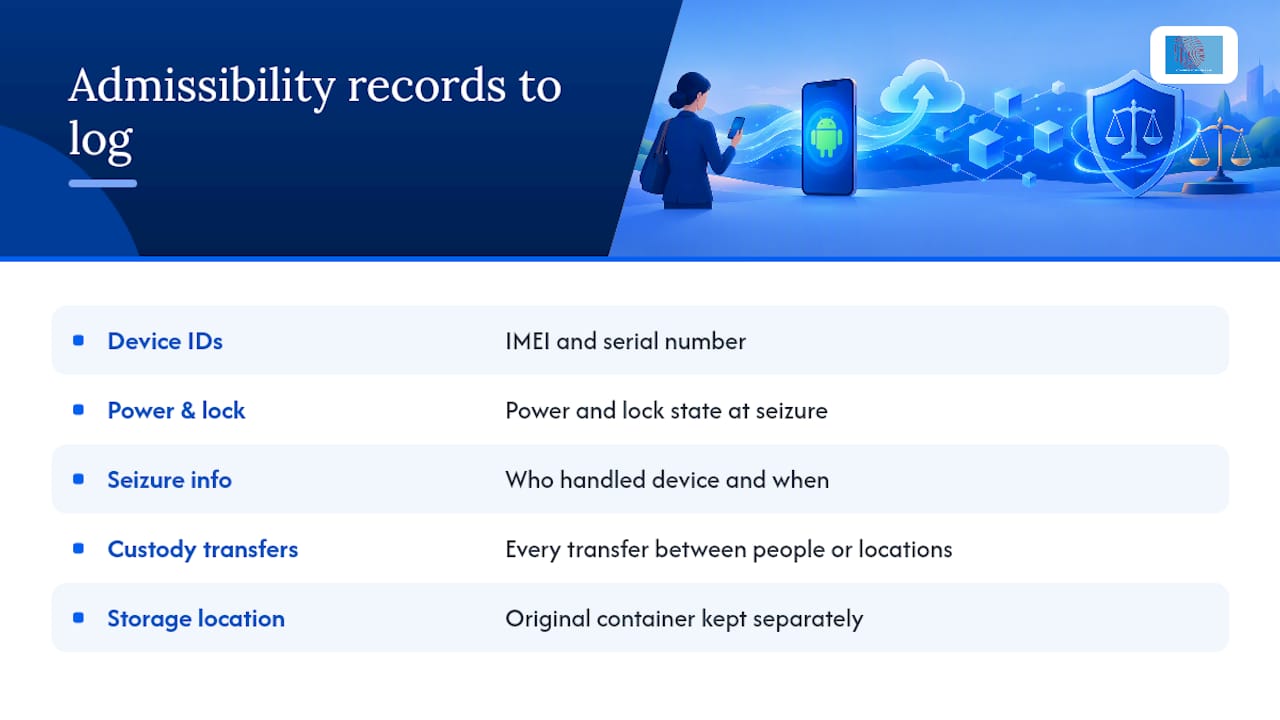
For anything sourced from Google, log the API calls made, the raw provider responses, the file manifest returned, and any hash or digital signature Google itself supplied with the export. NIST’s guidance on chain of custody is unambiguous on this point: acquisition without contemporaneous documentation is acquisition without evidential value, however technically sound the extraction was.
Where you convert a proprietary Google export into a readable format, record the conversion tool, the settings used, and compute a fresh hash of the converted file, while keeping the original container untouched and separately stored.
Backup passwords frequently differ from a device’s screen-lock passcode, and examiners who assume otherwise often abandon a recoverable backup as “encrypted” when a paired computer nearby holds the actual credential.
Your final report needs a stated methodology, the tools and versions used, validation steps taken against them, a plain statement of limitations, and an exhibit inventory formatted for disclosure or scheduling.
What obstacles will you hit, and how does a lab work around them?
Two-factor authentication is the obstacle instructing parties underestimate most. Harvesting a session token to bypass it is technically possible but legally fraught, and SWGDE’s guidance treats token extraction as carrying the same risk as direct cloud acquisition, so clear it with counsel before it happens, not after.
- Encrypted local backups often use a password distinct from the device passcode; check paired computers first, since password recovery can also be requested directly from Google as part of a wider export.
- Device and OS fragmentation across manufacturers means tool coverage is inconsistent, and some models require escalation to physical techniques.
- Provider production can arrive incomplete or in a proprietary format that needs validation against your local image before you rely on it.
| Obstacle | Typical mitigation | Evidential trade-off |
|---|---|---|
| 2FA / active session tokens | Counsel-approved token capture or await provider production | Token capture risks being treated as direct acquisition |
| Encrypted local backup | Search paired PC for saved credentials; request provider export | Delay if credentials cannot be located |
| Incompatible or older Android build | Escalate to physical extraction (JTAG, chip-off) | Physical methods can be destructive and yield encrypted dumps |
| Incomplete provider production | Cross-check against local device image | Google’s proprietary format may need conversion before comparison |
How Computer Forensics Lab handles Google-backup cases
Computer Forensics Lab supports the legal groundwork alongside the technical acquisition: helping draft preservation request language, running the cloud-forensic acquisition itself once legal process is in place, verifying every hash against the original, and preparing a witness-ready report. Every acquisition is logged against a documented chain of custody, and tools are selected with reference to recognised test specifications rather than convenience.
At instruction, expect to provide the legal authority document (order, warrant, or client consent), the account identifiers involved, any known passwords for the device or backup, and details of associated devices such as a paired laptop or tablet. The more precisely you scope the request at the outset, the faster the acquisition proceeds and the fewer gaps appear in the final report.
Instructing an engagement for Google-backup acquisition
Computer Forensics Lab is the practical alternative to piecing this together internally with generic IT support: where an in-house team can image a device, a lab experienced in cloud forensic analysis can run the acquisition, the preservation request coordination, and the expert witness reporting as one continuous, defensible process rather than three disconnected tasks handled by different people.
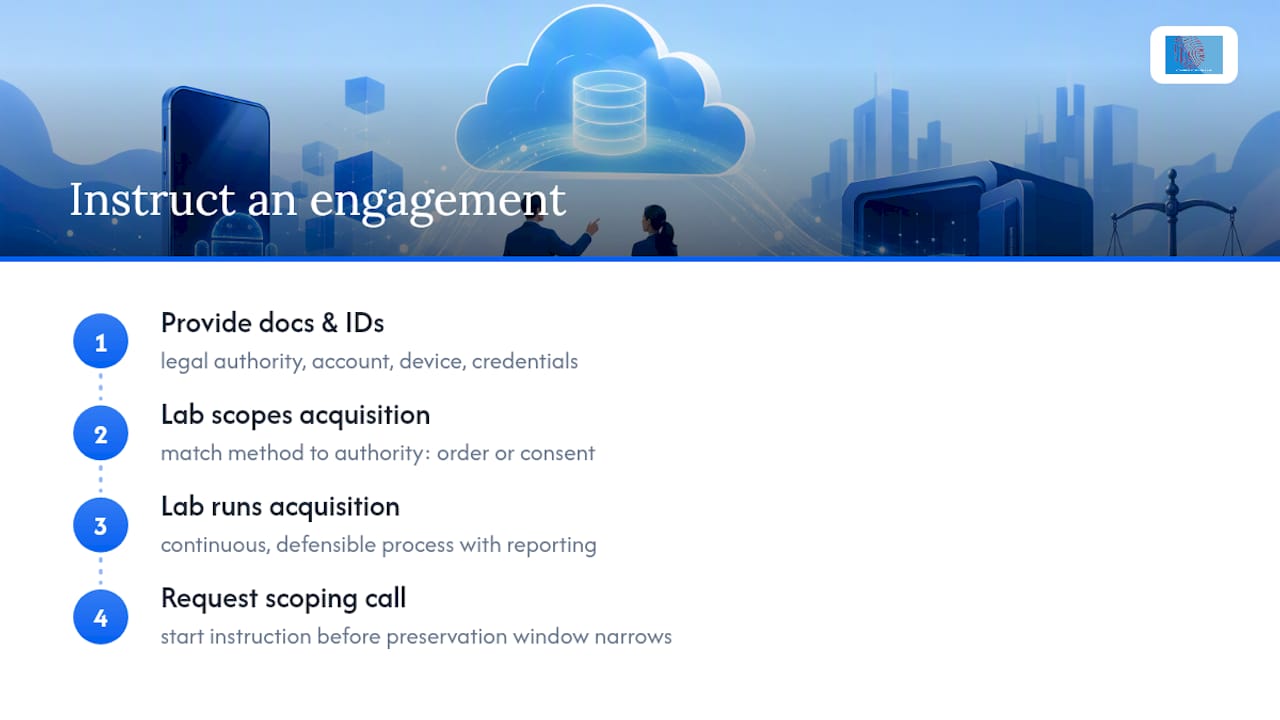
To instruct an engagement, send the legal authority document, the account and device identifiers, and any known credentials to the team first. From there, the lab scopes the acquisition method against the authority you actually hold, whether that is a court order awaiting provider production or immediate consent-based access to the device. Visit Computer Forensics Lab to start an instruction or request a scoping call before your preservation window narrows any further.
Sources
- Best practices for digital evidence acquisition from cloud service providers — SWGDE
- Mobile device forensic tool test specification v3.3 — NIST
- How Google handles government requests for user information — Google
- Google Takeout FAQ — Google Support
This article is general information, not a substitute for advice from a qualified lawyer. Consult a qualified legal professional about your own circumstances before acting on anything here.
FAQ
Can Google Takeout be used as forensic evidence on its own?
Not reliably. Google itself states that Takeout exports carry no chain-of-custody guarantee, so it works as a fast triage step with account-owner consent but should be backed by provider legal production or local device imaging for anything contested.
What is the difference between a preservation request and a subpoena?
A preservation request freezes existing account data against deletion but does not compel Google to release it. You still need a subpoena, court order, or warrant, matched to the sensitivity of the content, before Google will produce the actual data.
Does Google notify the account holder when law enforcement requests data?
Often, yes, depending on which Google entity handles the request and the jurisdiction involved. Google’s own policy sets out when notification happens and when emergency exceptions apply.
How does Computer Forensics Lab handle chain of custody for cloud acquisitions?
Every acquisition is logged against device identifiers, handling records, and timestamped transfers, with SHA-256 hashes computed and verified at each stage. Full details of the process are on the specialist forensics services page.
What should I send when instructing a Google-backup extraction?
Send the legal authority document, the account identifiers, any known device or backup passwords, and details of paired devices. Pricing for the engagement is available on request through Computer Forensics Lab.