
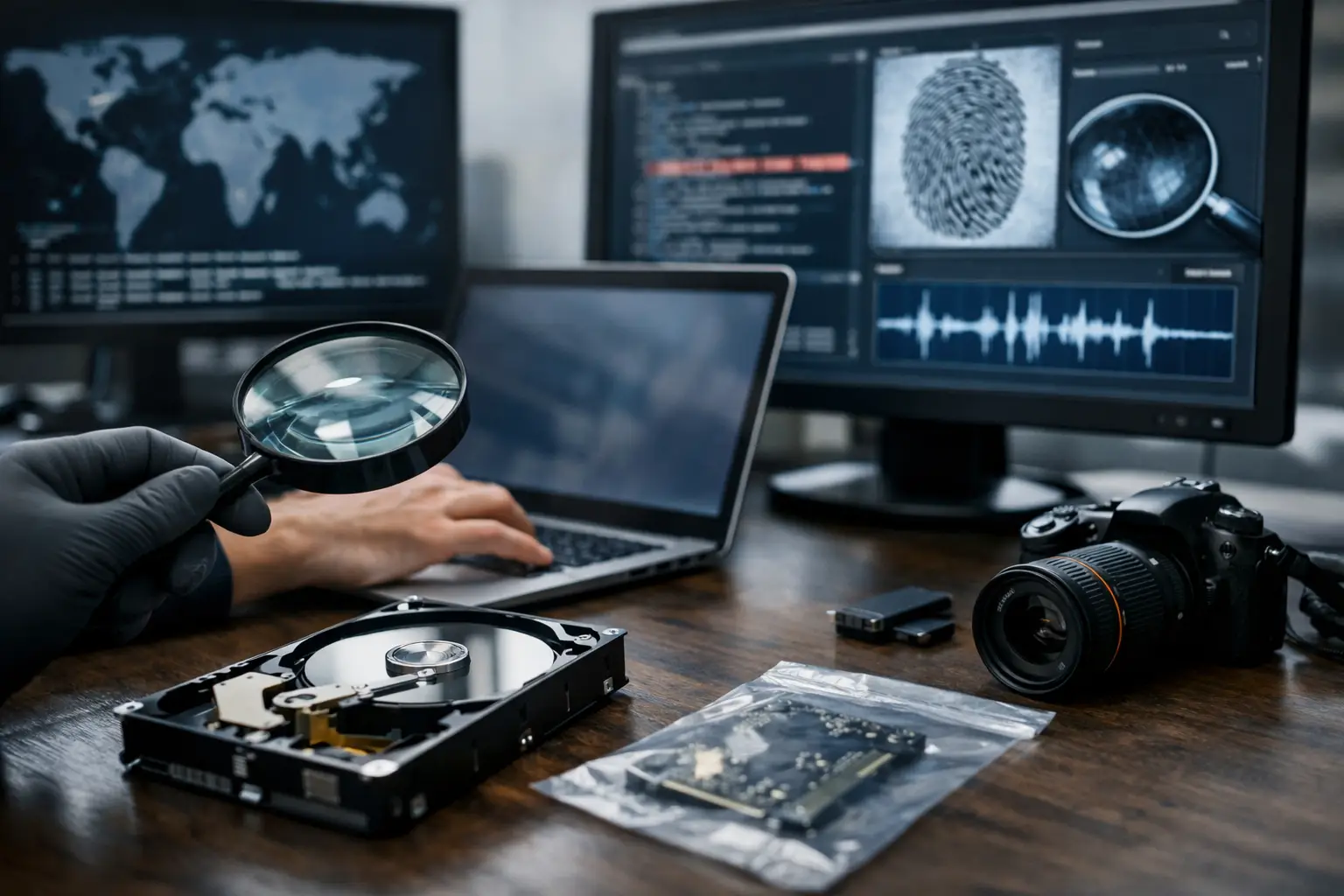
A ransomware alert, a suspected insider download or an unexpected mailbox rule can become a legal issue within hours. A guide to incident response forensics must therefore address more than technical containment. It must explain how to stop further harm while preserving reliable digital evidence, establishing what happened and producing findings that can withstand scrutiny from management, regulators, opposing parties or a court.
For solicitors and organisations, the central difficulty is that the quickest operational response can accidentally compromise the very evidence needed later. Rebooting a machine, deleting a malicious email, allowing a user to continue working, or asking internal IT to “have a look” may alter timestamps, overwrite volatile data or leave no clear record of who handled the device. The response must be proportionate, but it must also be disciplined from the first decision.
What incident response forensics is designed to achieve
Incident response is concerned with identifying, containing and recovering from a cyber or digital incident. Digital forensics is concerned with the careful identification, preservation, examination and presentation of evidence. Combined, incident response forensics answers two connected questions: how can the immediate risk be reduced, and what can be proved about the incident afterwards?
That distinction matters. An IT team may correctly remove malware or restore services, yet still be unable to determine which accounts were accessed, whether data was removed, or whether activity can be attributed to a particular user or device. A forensic investigation preserves the evidential trail needed to answer those questions with appropriate caveats.
The required scope depends on the allegation. A compromised cloud account may require authentication records, mailbox audit data, endpoint artefacts and relevant communications. A suspected employee data theft case may call for forensic imaging of a laptop and mobile telephone, USB history, cloud synchronisation evidence, printing records and an examination of relevant user activity. The purpose is not to collect every available byte. It is to preserve and examine material that is relevant, necessary and defensible.
The first hours: contain risk without destroying evidence
The first response should be led by a clear incident owner, with legal, technical and forensic roles defined early. Organisations often need to make urgent choices before every fact is known. Disconnecting an actively compromised endpoint from the network may be sensible; powering it down may not be. A live device can contain volatile information, including active network connections, running processes, encryption keys and unsaved data, which may disappear on shutdown.
Equally, leaving a system connected to preserve live evidence may permit further intrusion, encryption or exfiltration. There is no universal instruction to isolate, shut down or leave a device untouched. The decision turns on the live risk, the device’s role, the likely evidence available and the capabilities of those responding. The key is to document the rationale, time and person responsible for each action.
At this stage, preserve the surrounding records as well as the endpoint. Relevant sources may include firewall and VPN logs, identity-provider records, email security logs, cloud audit trails, backups, CCTV, access-control records and incident communications. Many logs have short retention periods or can be altered by ordinary business activity. Prompt preservation can be decisive.
A practical initial record should capture the report of the incident, known affected assets, users and accounts, actions taken, people involved, and the exact time source used. Screenshots alone are rarely sufficient for a forensic case, but they can help record transient alerts or dashboard views while fuller preservation is arranged.
A defensible incident response forensics process
A defensible process does not mean delaying urgent recovery until every item has been imaged. It means maintaining a method that allows another competent expert to understand what was received, what was done, what was found and the limits of those findings.
1. Identify and preserve the relevant evidence
The investigation begins by identifying potential evidence sources and securing them against alteration. Where appropriate, forensic practitioners create verified forensic copies rather than working directly on original media. Cryptographic hash values can demonstrate that a forensic image has not changed after acquisition.
For cloud-based material, preservation may involve exporting audit records, collecting account and tenant configuration, recording the method used to obtain data, and retaining native files with their available metadata. Cloud evidence requires particular care because administrators may unintentionally change settings or because logs may be retained only briefly. A clear record of access permissions, collection parameters and export times is essential.
Each exhibit should be uniquely identified. Its source, condition, date and time of receipt, handler, storage location and transfers should be recorded in the chain of custody. This is not administrative formality. It is how the party relying on evidence can account for its integrity.
2. Establish a reliable timeline
A timeline often becomes the spine of the investigation. It may correlate sign-in activity, suspicious file access, email forwarding, USB connections, browser activity, security alerts and physical access records. When assembled carefully, it can distinguish a genuine compromise from benign system activity, or identify gaps that require further enquiry.
Time is more complicated than it first appears. Devices may use different time zones, clocks may be inaccurate, and logs may record events at different stages of processing. A forensic report should state the time basis used and avoid presenting uncertain timing as fact. Where a timestamp supports a significant allegation, corroboration from an independent source is valuable.
3. Examine artefacts in context
Digital artefacts rarely speak for themselves. A file path may show that a document existed in a location; it may not prove that a person read, copied or understood its contents. An IP address may identify a connection; it may not conclusively identify the individual at a keyboard. Browser history, application databases, deleted material, link files, cloud-sync records and system logs must be interpreted alongside the device configuration and the wider evidence.
This is where impartiality matters. The examiner’s role is not to prove the client’s preferred account. It is to test competing explanations, identify supporting and contrary evidence, and state the limits of attribution. That approach makes the findings more useful in litigation and internal disciplinary processes alike.
4. Report findings for decisions and disclosure
A useful forensic report separates factual observations from expert interpretation. It should explain the items examined, methodology, tools and validation steps, relevant findings, and any limitations that could affect the conclusion. It should also use language that a solicitor, decision-maker or court can follow without concealing technical detail behind unexplained jargon.
The reporting format should be agreed with the case needs in mind. An early factual update may support urgent injunction, notification or employment decisions. A fuller report may be needed for proceedings, disclosure review or expert evidence. In UK matters, disclosure obligations, confidentiality, privilege and data-protection considerations should be addressed with the instructing legal team rather than treated as an afterthought.
5. Support recovery while protecting the investigation
Containment and restoration should proceed in a controlled way. Password resets, account revocation, endpoint rebuilds and patching can all be necessary, but each may affect available evidence. Before changes are made, decision-makers should consider whether relevant records have been preserved and whether the proposed action needs to be documented or witnessed.
Recovery also creates an opportunity to correct the weakness that enabled the incident. That may involve access-control changes, improved logging, revised leaver procedures, staff training or more reliable backup testing. However, remediation should not be allowed to overwrite the investigative record or collapse the distinction between what was observed and what was later changed.
Common mistakes that weaken an otherwise strong case
The most damaging errors are usually procedural rather than technical. Devices are handled by several people without a record. Original files are opened and saved. Screenshots replace underlying logs. An employee is questioned before relevant devices and accounts are preserved. A security supplier removes malicious content before recording it. These actions may be understandable under pressure, but they make later reconstruction more difficult.
Another common mistake is treating an incident as either purely technical or purely legal. A suspected breach may trigger operational, regulatory, employment, contractual and evidential issues at once. Early coordination between incident leads, legal advisers and independent forensic specialists helps prevent narrow decisions from causing wider damage.
When independent forensic expertise is needed
Not every security alert requires a full forensic examination. If an event is quickly explained, no sensitive data is involved and there is no dispute about what occurred, proportionate internal handling may be sufficient. The position changes where there is suspected criminality, employee misconduct, data theft, deletion, unauthorised access, significant financial loss, a likely claim, or any prospect that evidence will be challenged.
Independent expertise is particularly valuable where the organisation must demonstrate that its conclusions were reached fairly. A specialist can preserve and examine material without becoming part of the operational response, produce a transparent report, and assist solicitors with focused questions for disclosure, witness evidence or further investigation. Computer Forensics Lab approaches such matters with evidential integrity, documented handling and court-ready reporting at the centre of the process.
The strongest response is not necessarily the most extensive or expensive one. It is the response that acts quickly enough to reduce harm, preserves what matters, and leaves a clear evidential record for the decisions that follow. When an incident may become a dispute, treat the first device, log entry and instruction as potential evidence from the outset.