

More than 90 percent of british court cases now involve digital evidence at some stage, highlighting the urgent need for precise forensic knowledge. Legal professionals in London face increasing pressure to interpret specialised digital forensics terms accurately for effective case management and evidence admissibility. This overview clarifies the terminology and concepts that connect technical methods with legal standards, giving british criminal solicitors and corporate attorneys clear tools to strengthen their evidence handling and courtroom strategy.
Table of Contents
- Digital Forensics Terms And Core Concepts
- Types Of Evidence And Forensic Techniques
- Processes, Tools, And Examination Stages
- Legal Standards And Evidence Admissibility
- Risks, Responsibilities, And Common Pitfalls
Key Takeaways
| Point | Details |
|---|---|
| Digital Forensics Terminology | Mastering precise terminology is essential for effective communication and maintaining the integrity of forensic investigations. |
| Types of Evidence | Understanding the differences between volatile and non-volatile evidence is crucial for implementing appropriate collection techniques. |
| Investigation Methodology | Employing a structured approach in the digital forensic investigation process strengthens evidence handling and supports legal compliance. |
| Legal Standards | Adhering to established legal standards is vital for ensuring the admissibility and reliability of digital evidence in judicial proceedings. |
Digital forensics terms and core concepts
Digital forensics involves the systematic investigation and preservation of digital evidence across various technological platforms. Professionals in this field require precise terminology to ensure accurate communication and maintain the integrity of forensic investigations. Comprehensive digital forensic techniques involve understanding specialised terminology that bridges technical expertise with legal requirements.
Key core concepts in digital forensics encompass critical processes such as evidence acquisition, data preservation, and forensic analysis. Professionals must master techniques like creating forensically sound duplicate copies of digital media, implementing hash functions to verify data integrity, and conducting live system analysis. These methodologies help investigators retrieve, examine, and authenticate digital information while maintaining strict chain of custody protocols.
The terminology used in digital forensics serves multiple crucial purposes. It enables precise documentation, supports legal admissibility of evidence, and ensures standardised investigative practices. Terms like slack space (unused file system areas potentially containing deleted data), steganography (methods of concealing information), and write blockers (hardware preventing evidence modification) represent specialised language that distinguishes digital forensics as a sophisticated scientific discipline.
Expert Recommendation: Always maintain a comprehensive digital forensics glossary and regularly update your terminology knowledge to stay current with emerging technological investigations.
Here is a summary of major digital forensics terms and their unique roles:
| Term | Description | Role in Investigation |
|---|---|---|
| Slack Space | Unused file system area | May hold deleted evidence |
| Steganography | Concealing information within other data | Obscures data from detection |
| Write Blocker | Prevents data alteration on acquisition | Preserves evidence integrity |
| Hash Function | Generates unique code for data | Verifies authenticity and integrity |
Types of evidence and forensic techniques
Digital forensics encompasses a sophisticated range of evidence types that require meticulous handling and advanced investigative techniques. Forensic evidence categorisation involves understanding the complex landscape of digital information sources, including volatile and non-volatile data from various technological platforms.
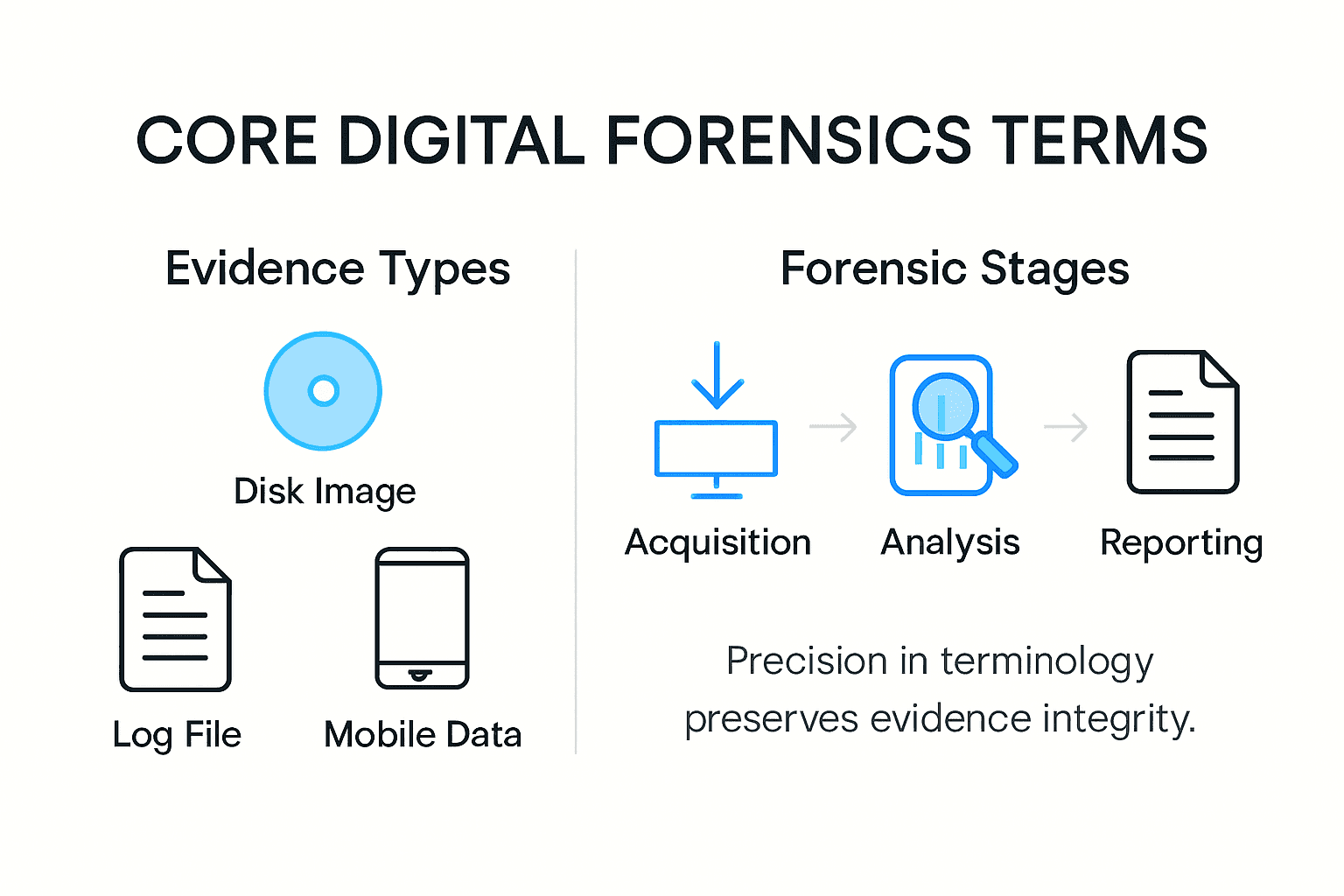

The primary types of digital evidence include internet-based data, stand-alone computer systems, mobile devices, and critical infrastructure systems. Each category demands unique forensic techniques for effective evidence collection and preservation. Volatile evidence represents dynamic data stored in system memory, requiring immediate acquisition to prevent loss, while non-volatile evidence includes persistent data stored on hard drives, solid-state drives, and other storage media that can be carefully extracted and analysed.
Forensic techniques are designed to maintain the integrity of digital evidence throughout the investigative process. These techniques involve critical steps such as evidence identification, static and live data acquisition, and forensic imaging. Investigators must prioritise evidence based on its potential value and volatility, ensuring that each piece of digital information is collected, documented, and preserved according to internationally recognised forensic standards. This approach guarantees the legal admissibility and reliability of digital evidence in criminal and civil proceedings.
Expert Recommendation: Always document every step of your digital forensic investigation with precise, timestamped notes and maintain a strict chain of custody to ensure the credibility of your forensic evidence.
Below is a comparison of volatile versus non-volatile evidence handling:
| Evidence Type | Persistence | Required Actions | Risks from Mishandling |
|---|---|---|---|
| Volatile | Lost when power off | Immediate capture needed | Data loss or alteration |
| Non-volatile | Remains when powered off | Careful extraction | Corruption or chain of custody errors |
Processes, tools, and examination stages
Digital forensic investigations follow a structured methodology that ensures systematic evidence handling and legal compliance. Digital forensic process stages encompass five critical phases that guide investigators through comprehensive evidence examination, each requiring specific expertise and precision.
The fundamental stages of digital forensic examination include identification, preservation, collection, analysis, and reporting. During the identification phase, investigators recognise relevant digital evidence and key data custodians. Preservation involves meticulously protecting electronically stored information and documenting the initial scene. Collection requires obtaining digital information through forensically sound imaging and copying techniques, ensuring no data modification occurs during extraction.

Specialised forensic tools play a crucial role in each examination stage. Investigators utilise advanced software and hardware solutions such as write blockers, forensic imaging systems, and comprehensive analysis suites. These tools enable forensic professionals to maintain data integrity, extract complex digital evidence, and perform in-depth investigations across various technological platforms. The analysis phase involves systematic examination to interpret digital artefacts, correlate evidence, and develop comprehensive insights that can support or challenge legal hypotheses.
Expert Recommendation: Continuously update your forensic toolkit and maintain rigorous training to stay ahead of evolving digital investigation technologies and methodologies.
Legal standards and evidence admissibility
Digital forensic evidence faces rigorous legal scrutiny to ensure its reliability and integrity in judicial proceedings. Harmonized digital evidence assessment standards require comprehensive evaluation of multiple critical factors, including search authorisation, evidence relevance, authenticity, and forensic methodology.
Courts demand meticulous documentation and validation of digital evidence collection processes. Legal admissibility hinges on demonstrating that forensic professionals followed standardised protocols, maintained chain of custody, and employed scientifically recognised techniques. This requires forensic experts to provide transparent documentation of their investigative methods, technological tools used, and precise analysis procedures that can withstand intense judicial scrutiny.
European legal frameworks emphasise the importance of establishing consistent standards for digital evidence. Key considerations include verifying data protection compliance, obtaining appropriate legal authorisations, and ensuring forensic methodologies meet stringent scientific and legal requirements. Forensic professionals must carefully navigate complex legal landscapes, presenting evidence that not only proves technological competence but also satisfies judicial standards of reliability and reproducibility.
Expert Recommendation: Maintain comprehensive, contemporaneous documentation of every forensic investigation step to support potential legal challenges and ensure evidence admissibility.
Risks, responsibilities, and common pitfalls
Digital forensics professionals face complex challenges that demand exceptional precision and ethical conduct. Digital forensic investigation risks encompass multiple critical dimensions that can fundamentally compromise evidence integrity and investigative outcomes.
The primary risks include potential data contamination, loss of volatile digital evidence, and inadvertent modification of critical forensic artifacts. Evidence preservation requires meticulous protocols to prevent unintentional alterations during acquisition and analysis. Forensic professionals must navigate complex technological landscapes while maintaining strict chain of custody, ensuring that every digital artifact remains uncompromised and legally admissible. Sophisticated techniques such as creating forensic write-protected images, documenting exact acquisition timestamps, and maintaining comprehensive audit trails become essential safeguards against potential investigative failures.
Professional responsibilities extend beyond technical competence to encompass ethical considerations and continuous learning. Digital forensic experts must stay current with rapidly evolving technological landscapes, understand complex jurisdictional requirements, and maintain rigorous standards of professional conduct. Common pitfalls include inadequate documentation, insufficient technical training, failure to follow standardised methodologies, and inability to communicate complex technical findings effectively to legal professionals and judicial systems. These challenges demand a holistic approach that combines technical expertise, legal understanding, and unwavering commitment to professional integrity.
Expert Recommendation: Implement systematic documentation protocols and participate in regular professional development to mitigate risks and maintain forensic investigation standards.
Achieve Precision in Digital Forensics with Expert Support
Understanding specialised digital forensics terminology is essential to overcome challenges such as maintaining evidence integrity, avoiding data contamination, and ensuring legal admissibility. Concepts like slack space, write blockers, and hash functions highlight the complexity of forensic investigations where precision is not optional but critical. If you have faced difficulties navigating these technical terms or worry about preserving a flawless chain of custody in your digital investigations, you are not alone.
At Computer Forensics Lab, we specialise in bridging the gap between complex digital forensic jargon and practical, legally sound outcomes. Our Digital Forensics experts provide meticulous data acquisition, advanced forensic analysis, and expert witness testimony designed to support legal professionals and organisations facing cybercrime, data breaches, or intellectual property theft. Start strengthening your case by partnering with trusted specialists who understand why precision matters so much in digital investigations.
Don’t risk uncertainty in your digital evidence. Explore our Computer Forensics services today and secure the expert assistance you need now at Computer Forensics Lab.
Frequently Asked Questions
What is digital forensics terminology?
Digital forensics terminology refers to the specialised language and terms used in the field of digital forensics, which is crucial for accurate communication, documentation, and the maintenance of evidence integrity during investigations.
Why is precision important in digital forensics?
Precision is vital in digital forensics because it ensures the accuracy of evidence collection, analysis, and reporting. Accurate terminology helps in maintaining a clear chain of custody and legal admissibility of evidence in court.
What are some key terms in digital forensics?
Key terms in digital forensics include ‘slack space’, which refers to the unused file system areas that may contain deleted data; ‘steganography’, which is the practice of concealing information; and ‘write blocker’, a tool that prevents data alteration during evidence acquisition.
How do legal standards impact digital forensics?
Legal standards impact digital forensics by requiring that evidence is collected and handled according to established protocols, ensuring that the forensic methodology used meets judicial requirements for reliability and admissibility in legal proceedings.