
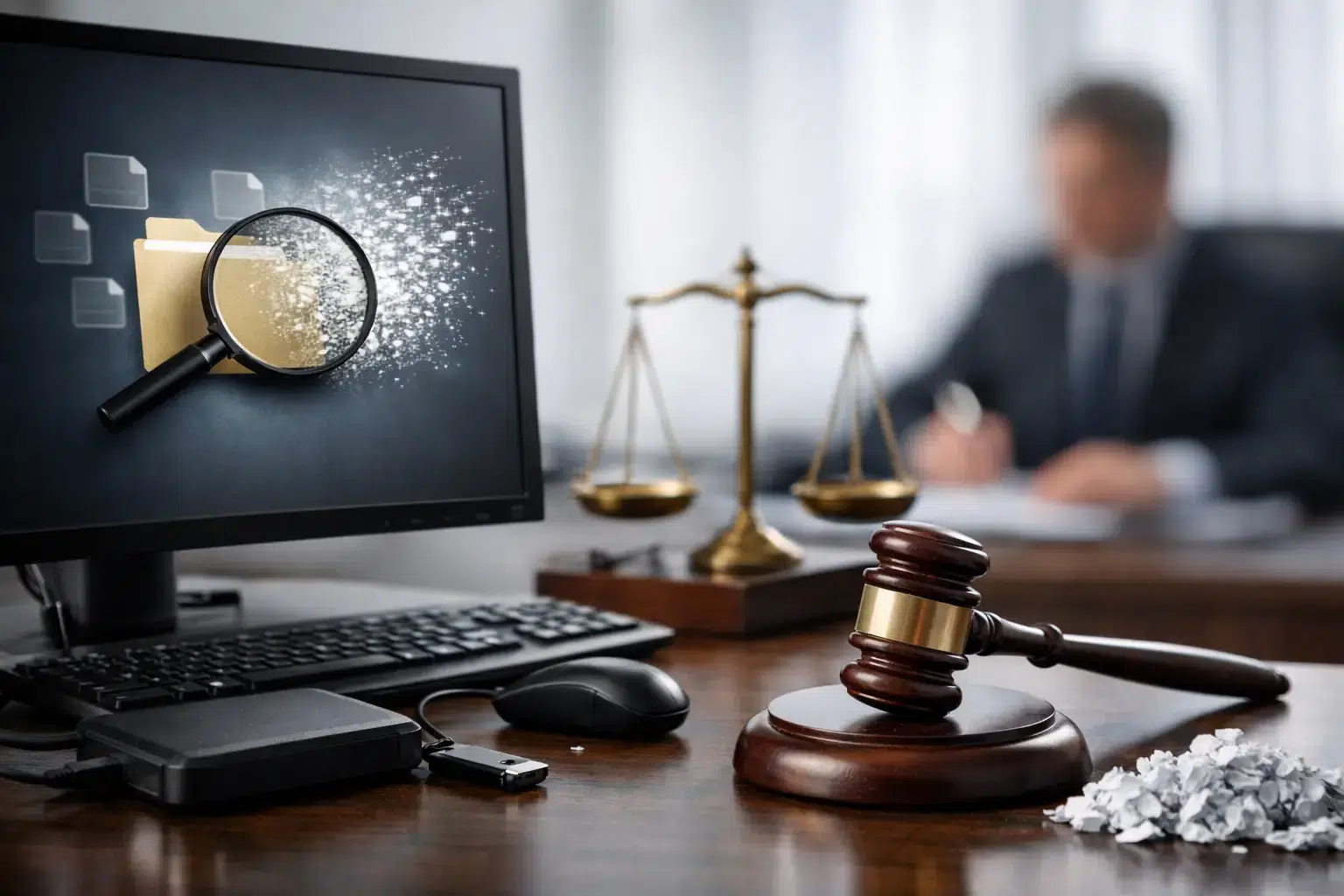
A missing document, message thread or photograph can become central to a dispute precisely because it is no longer visible. The first question is often direct: can deleted files be proven? In many cases, yes. But a defensible answer depends on what remains on the device, in associated systems and within the available audit trail. Recovering a file is only one part of the evidential picture. Establishing what happened, when it happened and who was responsible requires disciplined forensic examination.
Can deleted files be proven in a legal case?
Deleted files can sometimes be recovered in full, recovered in part, or proven through traces left elsewhere. A forensic investigator may identify file-system records, metadata, thumbnail caches, cloud synchronisation records, backups, application databases, email attachments, logs or references in documents created by other users.
The strength of the evidence varies. A recovered file may show its content and original filename. A directory entry may show that a file existed but not preserve its contents. A cloud audit log may record an account deleting an item at a particular time, while leaving open the question of who was physically using the account. Each finding must be presented for what it proves, and no more.
This distinction matters in civil litigation, criminal proceedings and internal investigations. It is not enough to say that data has been deleted. The relevant question may be whether a particular document existed, whether it was accessed, whether it was removed after a preservation request, or whether the deletion was deliberate. Digital evidence can assist with each issue, but the technical and factual limits must be made clear.
What deletion actually means on a device
On many traditional storage systems, deleting a file does not immediately erase its contents. The operating system typically marks the space previously occupied by the file as available for reuse. Until new data overwrites that space, portions of the deleted content may remain recoverable.
That principle should not be mistaken for a guarantee. Continued use of the device can overwrite deleted material quickly. The prospects of recovery may be reduced where the device has been reset, encrypted, securely wiped, heavily used after deletion or subject to automatic storage-management processes.
Solid-state drives require particular care. Features such as TRIM can instruct the drive to clear blocks that are no longer in use, often making conventional deleted-file recovery substantially more difficult than it would be on older mechanical hard drives. Mobile devices can also present challenges because modern encryption may render deleted data inaccessible once encryption keys have been removed.
Even where the underlying file cannot be restored, the deletion event may still be evidenced. That is why a forensic examination should not stop at a simple recovery scan.
The evidence that may survive a deletion
Digital activity leaves traces across a wider environment than most users expect. A forensic examiner assesses the device, its operating system, relevant applications, connected accounts and, where within scope, available backup or cloud sources.
Useful evidence can include the following:
- File-system metadata showing filenames, file paths, sizes, creation dates, modification dates or deletion-related records.
- Recycle Bin, Trash or application-specific deleted-item folders, which may retain data or metadata until emptied or purged.
- Backup data, including device backups, network backups, email archives and cloud version histories.
- Application artefacts, such as chat databases, document-recent lists, thumbnail caches, preview files and synchronisation records.
- System and security logs recording user sessions, removable-media activity, file sharing, remote access or account events.
- Cloud audit records that may show uploads, downloads, sharing changes, retention actions and deletion activity.
No single artefact should be viewed in isolation. A deleted spreadsheet, for example, might be supported by a recovered filename, a recent-documents entry, an email attaching the spreadsheet, a cloud version record and evidence that a user account was active at the relevant time. Corroboration gives the court or investigating party a clearer basis on which to assess reliability.
Proving existence is different from proving intent
Forensic evidence may establish that a file existed and was subsequently deleted. It may also show that deletion followed a particular sequence of activity. However, intent is often more difficult to prove from technology alone.
A file may have been deleted deliberately, accidentally, through a retention policy, during a system clean-up, by synchronisation from another device or as a consequence of an application update. Likewise, account activity is not automatically proof of the identity of the person operating the account.
An expert should therefore distinguish technical findings from ultimate legal conclusions. The evidence may support a proposition that deletion occurred from a specified account or device at a particular time. Whether that action was intentional, dishonest or undertaken by a named individual may depend on further evidence, including witness accounts, access arrangements, business records and the wider chronology.
Why preservation comes before recovery
The most damaging mistake is often made before an examiner is instructed. Switching on a computer, browsing through folders, logging into a cloud account, running recovery software or allowing a device to continue syncing can alter evidence. It may overwrite recoverable data, change timestamps, trigger remote deletion or compromise the ability to explain how the evidence was handled.
Where deleted files may be relevant to proceedings or an internal investigation, the device and associated accounts should be preserved promptly. A forensic acquisition is then carried out using appropriate methods, with cryptographic hash values used to demonstrate that the working copy and original evidence remain unchanged.
Chain of custody is not administrative formality. It records who handled the device or data, when it was received, how it was stored and what examination steps were performed. If the opposition challenges authenticity or contamination, a complete record allows the examiner to account for the evidence from collection to reporting.
For remote sources such as Microsoft 365, Google Workspace or other cloud platforms, preservation may involve securing audit records, retention data, account information and available versions before normal retention periods or user activity remove them. Speed is often decisive.
Can deleted files be proven when the original is gone?
Yes, sometimes the original content is unavailable but its existence and deletion can still be proven to a meaningful evidential standard. The appropriate conclusion will depend on the surviving artefacts.
Consider a director accused of removing commercially sensitive documents before leaving a business. The original files may no longer be recoverable from their laptop. Yet an examination could identify USB connection records, document shortcuts, file references in email, cloud synchronisation activity and evidence that folders were deleted shortly before departure. That does not automatically establish exfiltration, but it may provide a structured and testable evidential basis for further investigation.
In family and private-client matters, deleted messages or images may be partially recoverable from a device backup, notification cache, media thumbnail or linked cloud account. In cyber incident work, logs may establish deletion or alteration activity by a compromised account even where the affected files cannot be restored.
The right question is therefore not simply whether recovery software can find the file. It is whether the available digital evidence can reliably address the proposition that matters in the case.
What a court-ready forensic report should explain
A useful expert report does not overstate recovery results or present screenshots without context. It should identify the materials examined, the acquisition and preservation methods used, the tools and processes applied, and the relevant findings. It should also explain limitations, including missing devices, unavailable accounts, overwritten storage, timestamp uncertainty and the possibility of alternative explanations.
Dates and times deserve particular scrutiny. A timestamp may reflect file creation, copying, synchronisation, extraction, backup activity or a system clock that was incorrectly set. Time zone settings and daylight-saving changes can also affect interpretation. For that reason, a reliable report explains the source of each timestamp and avoids treating all dates as equivalent.
For legal teams, the report should translate technical evidence into clear propositions without sacrificing accuracy. It should enable solicitors, counsel and the court to understand what was found, how it was found, what it supports and where the evidential boundaries lie. Independence is essential. The examiner’s duty is to the evidence, not to a preferred narrative.
Acting when deletion is suspected
If deletion may be relevant, preserve first and investigate second. Avoid using the device or account unnecessarily, do not install recovery tools, and retain related devices, storage media, emails and account credentials where lawfully available. Record the circumstances in which the issue was identified, including relevant dates, people and systems.
Early forensic advice can define proportionate scope, identify volatile sources and prevent a costly loss of evidence. Computer Forensics Lab can examine devices and digital accounts using controlled forensic processes and provide transparent findings suitable for litigation, investigations and expert scrutiny.
A deleted file is not always a dead end. What matters is preserving the remaining evidence early enough for the digital record to speak with clarity.