

TL;DR:
- Secure evidence storage ensures the integrity, authenticity, and legal admissibility of physical and digital evidence through strict control and documentation. It protects against tampering, human error, cyber threats, and environmental degradation, which can compromise cases and legal outcomes. Ongoing compliance, standardized policies, and regular audits are essential for maintaining evidence integrity throughout its lifecycle.
Secure evidence storage is defined as the controlled preservation of physical and digital evidence under conditions that guarantee its integrity, authenticity, and admissibility throughout an investigation or legal proceeding. Chain of custody sits at the core of this process, and NIST confirms that standardised policies and written procedures are what assure consistent integrity across jurisdictions. Without those controls in place, evidence becomes vulnerable to challenge, exclusion, or outright loss before it ever reaches a courtroom. For legal professionals, law enforcement, and compliance officers, understanding why secure evidence storage is non-negotiable is the first step toward building a defensible case.
What risks does secure evidence storage protect against?
Evidence integrity fails in predictable ways, and most of those failures are preventable. SWGDE emphasises that accuracy, consistency, and reliability are the core principles of data integrity, and that both physical and logical controls are required to uphold them. When either layer is absent, the consequences range from inadmissible exhibits to collapsed prosecutions.
The primary threats to evidence integrity include:
- Tampering and unauthorised access. Physical evidence rooms without monitored entry logs and digital repositories without role-based access controls create opportunities for deliberate interference. A single unauthorised access event, even without malicious intent, can be enough for defence counsel to challenge the entire exhibit.
- Human error and documentation failures. Mislabelled items, incomplete transfer records, and missed audit entries are among the most common causes of chain of custody gaps. These are not dramatic failures; they are routine administrative oversights that carry serious legal weight.
- Cyber attacks and data breaches. Digital evidence stored without encryption or immutable audit trails is exposed to external intrusion and internal manipulation. A breach that alters file metadata or timestamps can destroy the forensic value of an exhibit entirely.
- Environmental degradation. Physical evidence stored without climate control deteriorates over time. Biological samples, printed documents, and storage media are all susceptible to humidity, temperature fluctuation, and contamination.
Pro Tip: Conduct a documented access review every quarter. Reviewing who accessed what, when, and why is one of the simplest ways to catch procedural drift before it becomes a courtroom problem.
Consider a scenario where a corporate fraud investigation produces several terabytes of email data. If that data sits on an unencrypted server with shared administrator credentials, any competent opposing counsel will argue that the evidence cannot be verified as unaltered. The case does not need to be lost on the facts; it can be lost on the storage.

How does secure storage support legal and compliance requirements?
Evidence admissibility in court depends on demonstrating that the material presented is the same material collected, and that nothing has changed in between. ASIS frames evidence storage as integral to maintaining data integrity and regulatory compliance, particularly in business settings where data privacy obligations intersect with investigative needs.
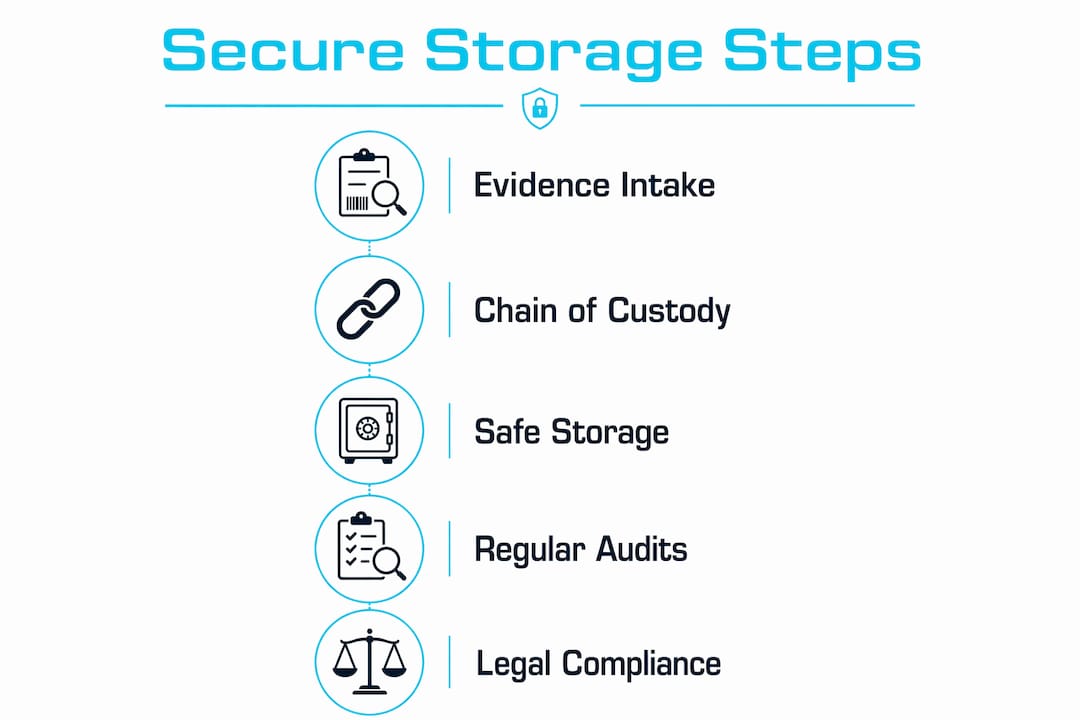
Meeting those requirements involves four distinct layers of compliance practice:
- Chain of custody documentation. Every transfer, access event, and storage location change must be recorded with timestamps, personnel identifiers, and purpose. NIST recommends routine audits and technology-based KPIs to measure and improve evidence management quality over time.
- Data privacy and retention alignment. UK GDPR, the Data Protection Act 2018, and sector-specific regulations such as CJIS in law enforcement contexts all impose obligations on how long evidence can be held, who can access it, and how it must be disposed of. Retention schedules that are not aligned with these frameworks create liability even when the underlying investigation is sound.
- Encryption and access governance. Digital Evidence Management Systems, commonly referred to as DEMS, incorporate encryption and immutable audit trails to meet CJIS standards. Role-based access controls mean that only authorised personnel can retrieve, copy, or modify stored exhibits.
- Standardised organisational policies. Two organisations using identical storage infrastructure can achieve very different legal outcomes if their procedural policies diverge. Consistent written procedures reduce jurisdictional variability and give courts confidence in the provenance of evidence.
“Secure evidence storage is not a technical checkbox. It is a continuous legal obligation that begins the moment evidence is collected and does not end until it is lawfully disposed of.”
Proper documentation of digital evidence handling is what converts raw data into legally defensible exhibits. Without it, even forensically sound material can be rendered inadmissible on procedural grounds alone.
Physical, digital, and hybrid storage: which solution fits?
The choice of storage architecture directly affects both the security of evidence and the speed at which it can be retrieved during legal review. Each approach carries distinct strengths, and the right choice depends on the nature of the evidence, the scale of the operation, and the applicable compliance framework.

| Storage type | Security features | Scalability | Key limitation |
|---|---|---|---|
| Physical | Climate control, monitored access, chain of custody logs | Limited by facility capacity | Retrieval is manual and time-intensive |
| Digital (DEMS) | Encryption, role-based access, automated audit trails | High; cloud-based options scale on demand | Requires ongoing cybersecurity maintenance |
| Hybrid | Combines physical security with digital indexing and access controls | Flexible; adapts to mixed evidence types | Higher implementation complexity |
Forensic-grade physical storage facilities use climate control, monitored security, and chain of custody documentation to protect evidence over extended periods. These environments are well suited to biological samples, weapons, and original documents where physical condition is legally significant.
Digital storage, by contrast, excels at scale and retrieval speed. Metadata indexing and tiered archiving reduce the risk of evidence overwrite and produce faster retrieval during legal review. A major police force managing hundreds of thousands of body-worn camera files, for example, cannot rely on manual physical retrieval. Automated DEMS platforms make that volume manageable without sacrificing integrity.
Hybrid approaches are increasingly common in organisations that handle both physical exhibits and large volumes of digital data. The physical component maintains custody of original items, while the digital layer provides searchable, auditable records of every interaction with those items.
Pro Tip: When evaluating storage solutions, test retrieval time under realistic load conditions. A system that performs well with 1,000 files but degrades at 100,000 will create operational bottlenecks precisely when time pressure is highest, during active litigation.
Best practices for implementing secure evidence management
Effective evidence storage does not emerge from technology alone. It requires a combination of written policy, trained personnel, and systems that enforce compliance automatically rather than relying on individual diligence.
The following practices form the operational foundation of any credible evidence management programme:
- Written policies and routine audits. Documented procedures must cover intake, storage, access, transfer, and disposition. Standardised policies prevent the procedural variability that undermines legal defensibility. Audits should be scheduled, not reactive.
- Role-based access controls and audit logging. Every access event should be attributed to a named individual with a recorded justification. Systems that log access automatically remove the risk of incomplete manual records.
- Metadata-driven indexing. Tagging evidence with case identifiers, collection dates, custodian names, and file hashes at the point of intake makes retrieval faster and verification simpler. SWGDE’s best practices for digital evidence collection stress thorough documentation as a defence against both tampering and accidental data loss.
- Retention and disposition automation. Manual retention management creates gaps. Automated workflows that flag evidence for review, archival, or destruction at defined intervals reduce the risk of unlawful retention and ensure that disposal is documented.
- Continuous training for evidence handlers. Personnel who understand why each procedure exists are more likely to follow it correctly under pressure. Training should cover both the technical operation of storage systems and the legal consequences of procedural failure.
Reviewing evidential handling best practices regularly keeps teams aligned with current standards, particularly as digital evidence types and applicable regulations continue to evolve.
Key takeaways
Secure evidence storage is the foundation of legal admissibility, and no amount of forensic skill compensates for a broken chain of custody or a compromised storage environment.
| Point | Details |
|---|---|
| Chain of custody is non-negotiable | Every access, transfer, and storage event must be documented to maintain legal defensibility. |
| Compliance drives storage design | UK GDPR, CJIS, and sector regulations dictate retention, access, and disposal requirements. |
| Technology must match evidence volume | DEMS platforms with encryption and audit trails are required for high-volume digital evidence. |
| Policies prevent procedural drift | Written, audited procedures reduce variability that opposing counsel can exploit in court. |
| Retention automation reduces risk | Automated disposition workflows prevent unlawful retention and ensure documented destruction. |
The uncomfortable truth about evidence storage failures
From working across criminal investigations, civil litigation, and corporate forensics, the pattern I see most often is not dramatic. Organisations do not typically lose cases because someone deliberately tampered with evidence. They lose them because a well-intentioned analyst accessed a file without logging the reason, or because a retention schedule was never updated after a regulatory change, or because a storage system that worked fine at low volume became unreliable as case numbers grew.
NIST’s 2025 findings confirm what I have observed directly: two organisations using similar storage infrastructure can achieve very different legal outcomes purely because of procedural variability. That is a sobering finding. It means the investment in technology is only half the answer. The other half is the discipline to enforce consistent procedures across every person who touches evidence, every time.
The organisations that handle this well treat storage integrity as a continuous process, not a setup task. They audit regularly, train proactively, and build systems that make compliance the path of least resistance rather than an additional burden. The ones that struggle tend to treat secure storage as a solved problem once the initial system is in place. It never is.
If you are evaluating your current approach, the question to ask is not whether your storage system is secure in theory. It is whether every person in your team could demonstrate an unbroken, documented chain of custody for every exhibit in an active case, right now, under cross-examination.
— Computer
How Computerforensicslab supports secure digital evidence management
Computerforensicslab provides professional digital forensics services to legal teams, law enforcement, and businesses across the UK, with secure evidence management at the centre of every investigation. The team handles encrypted storage, chain of custody documentation, and audit-ready reporting for digital exhibits ranging from mobile devices and cloud data to corporate networks and social media accounts. For organisations that need to understand the full scope of their digital evidence footprint, Computerforensicslab offers structured forensic analysis that meets court-admissible standards. Every engagement is built around maintaining integrity from collection through to disclosure, so that the evidence you present is evidence that holds.
FAQ
What is secure evidence storage?
Secure evidence storage is the controlled preservation of physical and digital evidence under conditions that protect its integrity, authenticity, and admissibility. It encompasses chain of custody documentation, access controls, encryption, and retention policies aligned with applicable legal standards.
Why does chain of custody matter for evidence storage?
Chain of custody is the documented record of every person who accessed, transferred, or handled evidence. Gaps in that record give opposing counsel grounds to challenge admissibility, regardless of the underlying forensic quality of the evidence.
What regulations govern digital evidence storage in the UK?
Digital evidence storage in the UK is subject to UK GDPR, the Data Protection Act 2018, and sector-specific frameworks such as CJIS for law enforcement. ASIS confirms that secure sharing and retention policies are central to meeting these obligations.
What is a Digital Evidence Management System?
A Digital Evidence Management System, or DEMS, is a platform that centralises the storage, access, and audit of digital evidence. DEMS platforms incorporate encryption, role-based access controls, and immutable audit trails to meet legal admissibility standards and support high-volume evidence management.
How often should evidence storage procedures be audited?
Evidence storage procedures should be audited on a scheduled basis, at minimum annually, with additional reviews triggered by regulatory changes or significant increases in evidence volume. NIST recommends technology-based KPIs to measure management quality and identify procedural gaps before they affect case outcomes.