

TL;DR:
- Data preservation involves active management of digital information to ensure long-term security, accessibility, and usability. It goes beyond simple backups by continuously checking data integrity, converting formats, and maintaining documentation to prevent obsolescence and corruption.
Data preservation is defined as the active, long-term management of digital information to keep it secure, accessible, and usable over time. Unlike a simple backup, it is a continuous process that addresses threats like bit rot, software obsolescence, and format decay. For individuals, businesses, and legal professionals, understanding what is data preservation means recognising that storing a file is not the same as protecting it. The stakes are high: corrupted evidence can collapse a legal case, and lost records can trigger regulatory penalties. This guide covers the core techniques, the importance of digital data preservation, and the best practices that separate genuine preservation from false security.
What is data preservation and why does it go beyond storage?
Data preservation is an active management strategy that secures digital records against obsolescence, corruption, and compliance failures over an indefinite period. Storage simply holds data. Preservation actively monitors, validates, and migrates it so the data remains readable and legally sound years or decades from now.

The distinction matters because digital files degrade silently. A hard drive can report no errors while individual bits flip and corrupt a document at the sector level. This phenomenon, known as bit rot, is undetectable without periodic integrity checks. Preservation programmes build those checks into a regular cycle.
Preservation also addresses technological obsolescence. A file saved in a proprietary format from 2005 may be unreadable today because the software no longer exists. Active preservation converts files to open, non-proprietary formats before that window closes. That is why the practice is far more than a storage decision. It is an operational commitment.
What are the key processes and techniques involved?
The EOSC EDEN framework defines 30 core preservation processes that any trustworthy archive should implement. These processes are system-agnostic, meaning they apply whether you manage a corporate server or a legal evidence repository. The most critical include:
- Checksum generation and validation. A checksum is a mathematical fingerprint of a file. Recalculating it periodically reveals whether the file has changed, even silently. This is the primary method for detecting bit rot before data becomes unusable.
- File format normalisation. Converting proprietary files to open standards such as PDF/A, CSV, or XML removes dependency on specific software. File format normalisation to open standards is vital for ensuring future accessibility despite software obsolescence.
- Virus scanning and malware detection. Ingesting data into a preservation environment without scanning it risks contaminating the entire archive.
- Metadata extraction and documentation. Metadata records the context of a file: who created it, when, using what system, and for what purpose. Without metadata, a file may be technically intact but practically uninterpretable.
- File migration. As storage media and formats age, data must be migrated to current media and formats on a planned schedule.
Metadata tagging ensures future users and auditors can interpret, verify, and understand data context years after creation. This is not optional for legal or regulated environments. It is a prerequisite for admissibility and compliance.
Pro Tip: Always document the provenance of a file at the point of ingest. Recording the source device, acquisition method, and timestamp creates an unbroken chain of custody that no amount of retrospective documentation can replicate.

Why is data preservation important for different audiences?
The importance of data preservation varies by context, but the underlying risk is the same: losing access to information that cannot be recreated.
For legal professionals, preserving digital evidence requires maintaining integrity and accessibility consistent with legal standards to ensure admissibility in court. A file that has been altered, even accidentally, may be ruled inadmissible. Preservation protocols, including write-blocking during acquisition and checksum verification, protect against that outcome. Legal teams managing litigation data preservation face strict disclosure obligations that make informal storage practices a serious liability.
For businesses, the risks include regulatory non-compliance, loss of institutional knowledge, and vulnerability during audits. Organisations subject to GDPR, the Companies Act 2006, or sector-specific regulations must retain certain records for defined periods in a readable and verifiable format. Relying on an ageing proprietary system to hold those records is not a preservation strategy. It is a liability.
For individuals, the concern is more personal but no less real. Family photographs stored in a cloud service that closes, or documents saved in a format no longer supported, are effectively lost. Digital document security practices that include format migration and redundant storage prevent that loss.
The risks that preservation mitigates include:
- Regulatory penalties for non-compliant record retention
- Evidence being ruled inadmissible due to integrity failures
- Permanent loss of records due to media failure or format obsolescence
- Reputational damage following a data breach or audit failure
- Loss of institutional knowledge when staff leave or systems change
How does data preservation differ from a simple backup?
Backups are static copies for short-term recovery, whereas digital preservation actively manages risks like bit rot and software obsolescence over the long term. This is the clearest way to state the difference. A backup answers the question: “Can I restore this file if it is deleted?” Preservation answers a harder question: “Will this file still be readable, verifiable, and legally sound in ten years?”
A backup taken today captures the file as it exists now. If that file is already corrupted, the backup preserves the corruption. Preservation, by contrast, validates integrity at ingest and continues to monitor it. The 3-2-1 backup rule, which calls for three copies on two different media types with one stored off-site, is foundational but insufficient alone for long-term preservation. It addresses redundancy, not longevity.
Preservation adds three layers that backups do not provide:
- Policy and governance. A preservation policy defines retention periods, review cycles, and destruction procedures. Backups have no equivalent governance layer.
- Format management. Preservation actively converts files to formats that will remain readable. Backups copy files in whatever format they currently exist.
- Metadata and documentation. Preservation records context. Backups record only the file.
Pro Tip: If your organisation relies solely on nightly backups to meet compliance obligations, you are almost certainly not meeting them. A backup is not a preservation record. Regulators and courts treat them differently.
What are the leading best practices for data preservation?
Best practice involves using open, non-proprietary formats such as CSV, PDF/A, and XML, combined with metadata documentation, redundant storage, and regular integrity validation. These are not aspirational guidelines. They are the minimum standard for any organisation with legal, regulatory, or long-term operational responsibilities.
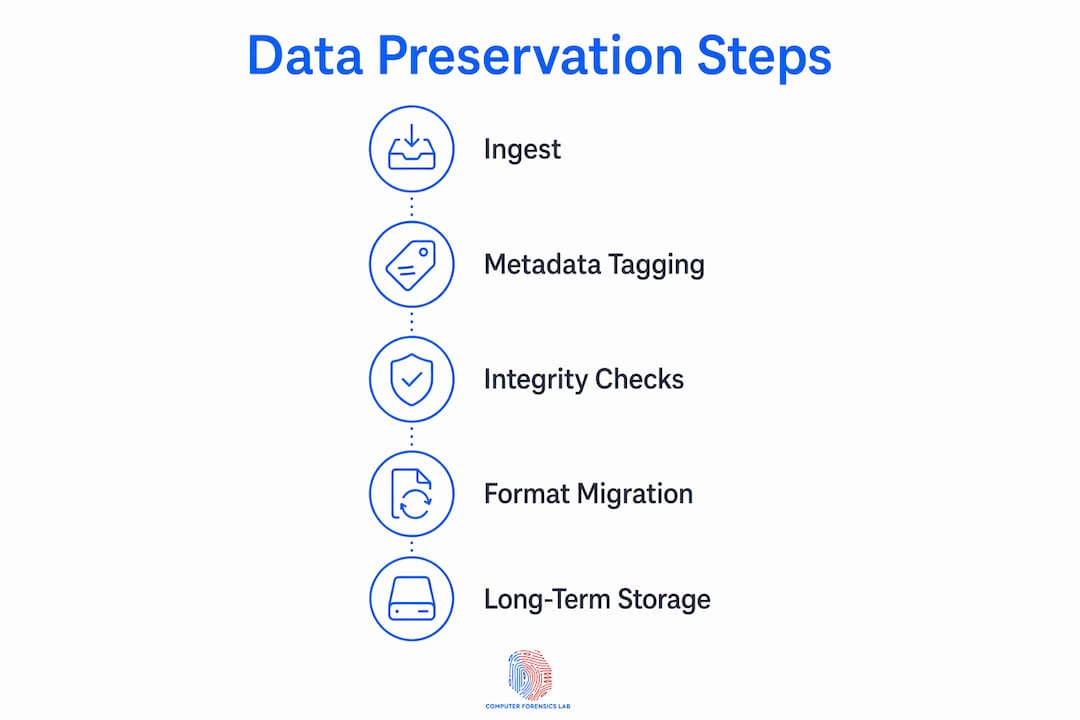
A structured lifecycle approach covers five stages:
- Ingest. Acquire data with integrity checks and full provenance documentation at the point of entry.
- Validation. Run checksums, virus scans, and format checks before the data enters the preservation environment.
- Storage. Apply the 3-2-1 rule as a baseline, then add geographically distributed copies for critical records.
- Migration. Schedule regular reviews to identify formats and media approaching obsolescence, and migrate proactively.
- Access. Maintain findability through metadata standards and, where appropriate, persistent identifiers such as DOIs that create stable, citable references to datasets.
Recognised repositories commit to long-term preservation and metadata enrichment, supporting FAIR data principles: Findable, Accessible, Interoperable, and Reusable. For organisations managing research or regulated data, depositing into a certified repository is often the most reliable preservation path available.
Experts advise viewing preservation as an ongoing operational cycle that bridges research data management and active technical preservation. This framing is useful because it positions preservation not as a one-off project but as a permanent operational function, like security patching or financial auditing.
| Stage | Key action | Primary risk addressed |
|---|---|---|
| Ingest | Checksum generation and provenance logging | Undetected corruption at entry |
| Validation | Format normalisation and virus scanning | Proprietary lock-in and malware |
| Storage | 3-2-1 rule plus geographic distribution | Media failure and site-level disaster |
| Migration | Scheduled format and media review | Technological obsolescence |
| Access | Persistent identifiers and metadata standards | Loss of findability and context |
Key takeaways
Effective data preservation requires active management, not passive storage, combining integrity validation, format normalisation, and governance policy to keep digital records legally sound and accessible over time.
| Point | Details |
|---|---|
| Preservation is not backup | Backups are static recovery tools; preservation actively manages format, integrity, and policy over the long term. |
| Checksums detect silent corruption | Periodic checksum validation catches bit rot before a file becomes permanently unreadable or legally compromised. |
| Open formats protect longevity | Converting files to PDF/A, CSV, or XML removes dependency on proprietary software that may not exist in future. |
| Metadata is legally critical | Metadata documents provenance and context, making files interpretable and admissible years after creation. |
| Governance defines the difference | A preservation policy with defined retention periods and review cycles separates genuine compliance from informal storage. |
What I have learned from working with data preservation failures
The most common mistake I see organisations make is treating a backup schedule as a preservation programme. They are not the same thing, and the gap between them tends to surface at the worst possible moment: during litigation, a regulatory audit, or a data breach investigation.
Organisations often err by relying solely on basic backups, and the consequences range from inadmissible evidence to significant regulatory penalties. What strikes me is how preventable these failures are. A structured preservation policy, even a modest one, would have caught the problem years before it became a crisis.
The other pattern I see is format neglect. Files sit in proprietary formats for a decade, and nobody notices until the software is decommissioned and the files become unreadable. File format normalisation is not a complex technical task. It is a scheduled administrative one. The organisations that do it well treat it like any other maintenance cycle.
The future of data preservation will be shaped by two pressures: increasing data volumes and tightening legal frameworks. Both demand a more disciplined, proactive approach. The organisations that build preservation into their operations now will be far better positioned when those pressures intensify.
— Computer
How Computerforensicslab supports data preservation for legal and corporate clients
Computerforensicslab provides professional digital forensics services to legal professionals, businesses, and law enforcement across the UK. Its work includes evidence acquisition, integrity validation, and chain of custody documentation, precisely the processes that sit at the heart of any serious preservation programme. For clients facing litigation, regulatory scrutiny, or a data breach, Computerforensicslab applies forensic-grade methods to ensure that digital records remain admissible and verifiable. The team also supports evidence collection for investigations, providing the technical rigour that informal storage practices cannot match. Contact Computerforensicslab to discuss your specific preservation or investigation requirements.
FAQ
What is data preservation in simple terms?
Data preservation is the active, ongoing process of keeping digital files secure, readable, and verifiable over time. It goes beyond backup by managing format changes, integrity checks, and documentation.
How does data preservation differ from data backup?
A backup is a static copy used for short-term disaster recovery. Preservation actively manages risks like bit rot and format obsolescence, and includes governance policies and metadata documentation that backups do not provide.
Why is metadata important in data preservation?
Metadata records the context of a file, including its origin, creation date, and handling history. Without it, a file may be technically intact but uninterpretable or inadmissible in legal proceedings.
What file formats are best for long-term preservation?
Open, non-proprietary formats such as PDF/A, CSV, and XML are the standard recommendation. They remain readable without dependency on specific software that may become unavailable.
What is the 3-2-1 rule and is it enough for preservation?
The 3-2-1 rule calls for three copies of data on two different media types with one stored off-site. It is a sound baseline for redundancy but insufficient alone for long-term preservation, which also requires format management, integrity validation, and governance policy.