

TL;DR:
- Data breach analysis involves a detailed forensic investigation to identify how unauthorized access occurred and what data was compromised.
- It produces legally admissible findings that are essential for regulatory compliance and legal proceedings.
Data breach analysis is the forensic examination of a security incident involving unauthorised access to sensitive information. The process determines how the breach occurred, what data was compromised, and who was responsible. Regulatory frameworks such as GDPR and oversight bodies including the ICO (Information Commissioner’s Office) require organisations to conduct thorough breach investigations and notify affected parties within strict timeframes. Computerforensicslab provides specialist forensic investigation services to businesses, legal professionals, and individuals who need to understand the full scope of a breach and meet their legal obligations.
What is data breach analysis and what does it involve?
Data breach analysis is the structured forensic process of investigating, documenting, and understanding a security incident involving unauthorised access to data. The industry standard term for this process is a forensic breach investigation, and it covers far more than simply identifying that a breach occurred. A thorough breach investigation identifies the initial access vector, the full blast radius of the attack, and the exact data that was exfiltrated.

The distinction between a surface-level audit and a forensic investigation matters enormously in legal and regulatory contexts. A forensic investigation produces findings that withstand legal scrutiny, whereas a quick internal review rarely does. For legal professionals, this difference can determine whether evidence is admissible in court. For businesses, it determines whether a regulatory penalty is avoidable.
Forensic imaging sits at the core of any credible investigation. This technique creates a bit-for-bit copy of affected storage media, allowing investigators to analyse data without altering the original. That integrity is what makes findings legally admissible.
What are the key steps involved in data breach analysis?
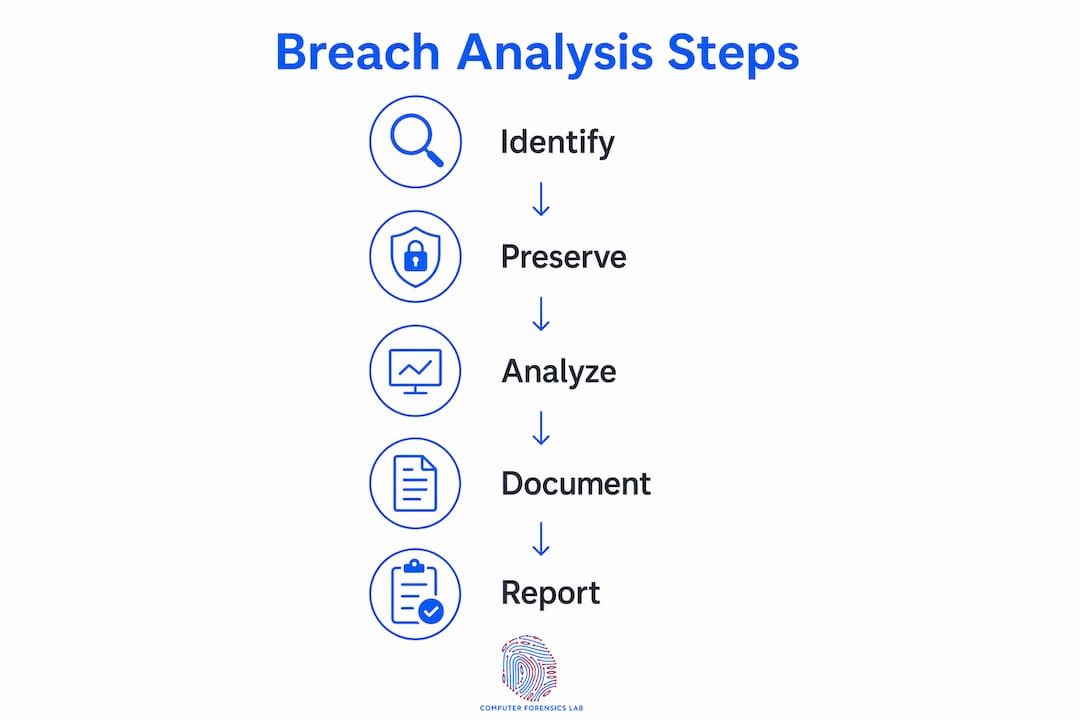
A structured breach response follows a defined sequence. Each phase builds on the last, and skipping any step creates gaps that undermine both the investigation and any subsequent legal proceedings.
- Detection. Identify that a breach has occurred, using security alerts, anomaly detection, or third-party notification.
- Containment. Isolate affected systems to prevent further data loss without destroying evidence.
- Forensic investigation. Collect and analyse digital evidence to establish the cause, scope, and timeline of the breach.
- Risk assessment. Evaluate the sensitivity of compromised data and the potential harm to affected individuals.
- Regulatory notification. Notify the ICO, OAIC, or other relevant authority where required, and inform affected individuals if the risk of harm is serious.
- Eradication and recovery. Remove attacker access, patch vulnerabilities, and restore systems to normal operation.
- Post-incident review. Identify root cause, assess the effectiveness of the response, and implement corrective controls.
Post-incident reviews are not optional extras. Root cause analysis after a breach identifies whether attacker persistence mechanisms remain active, which remediation alone frequently misses. Without this step, organisations often face repeat incidents within months.
Pro Tip: Capture a full memory dump before rebooting or powering down any affected system. Encryption keys, active network connections, and running processes exist only in volatile memory. Once the system restarts, that evidence is gone permanently.

How does data breach analysis differ from remediation?
Remediation closes the door. A forensic investigation identifies who opened it, what they took, and how to make those findings stand up in court. These are distinct objectives, and conflating them is one of the most costly mistakes an organisation can make after a breach.
Remediation is reactive. It focuses on restoring operations, patching the exploited vulnerability, and getting systems back online. A forensic investigation, by contrast, prioritises evidentiary integrity above speed. Investigators follow chain-of-custody procedures, document every action taken, and produce findings that regulators and courts can rely on.
Skipping the forensic stage creates several specific risks:
- Incomplete scope. Remediation teams patch the known entry point but miss secondary backdoors or persistence mechanisms left by the attacker.
- Unknown data loss. Without forensic analysis, organisations cannot confirm exactly which records were accessed or exfiltrated, making accurate notification impossible.
- Regulatory exposure. The ICO expects organisations to demonstrate that they investigated a breach thoroughly. An absence of forensic documentation weakens that case significantly.
- Legal vulnerability. If litigation follows, findings from a non-forensic review are unlikely to be treated as reliable evidence.
Pro Tip: Engage a forensic investigator before your IT team begins remediation work. Remediation actions such as reimaging drives or resetting credentials can overwrite the very evidence an investigation depends on.
What modern challenges affect data breach analysis in 2026?
The threat environment has shifted considerably. AI-driven social engineering and deepfake-facilitated attacks now represent a significant proportion of breach vectors, and they leave subtler forensic traces than traditional malware. Investigators in 2026 need a broader toolkit and a wider view of the attack surface than was sufficient even three years ago.
Internal logs alone are no longer sufficient for a complete investigation. Sophisticated attackers routinely disable or manipulate logging systems before exfiltrating data. This is why External Attack Surface Management (EASM) has become a standard component of modern breach investigations. EASM provides an outside-in view of how an attacker saw and accessed the organisation’s perimeter, independent of internal records.
Several specific challenges now complicate the data breach assessment process:
| Challenge | Impact on investigation |
|---|---|
| AI-generated phishing and deepfakes | Harder to attribute breach origin; social engineering leaves minimal technical traces |
| Shadow IT | Unmanaged devices and applications create blind spots outside standard monitoring |
| Exposed cloud infrastructure | Misconfigured cloud assets are frequently exploited but absent from internal logs |
| Notification fatigue | Over-notification desensitises individuals; under-notification creates regulatory risk |
| Volatile evidence loss | Premature system shutdown destroys memory-resident evidence before capture |
Shadow IT and exposed cloud infrastructure are frequent blind spots that must be assessed externally during any investigation. Organisations that rely solely on their own security teams to scope a breach often underestimate the attack surface by a significant margin. An independent forensic team brings objectivity and external visibility that internal teams structurally cannot provide.
Memory forensics has become a non-negotiable discipline. Volatile data such as encryption keys and active network connections exist only in live system memory. Collecting memory dumps before any system is powered down is now a baseline expectation in professional forensic investigations, not an advanced technique.
What should organisations do after a data breach analysis?
A completed forensic investigation is the starting point for a structured response, not the end of the process. Swift action after a breach minimises further data loss, preserves remaining evidence, aids regulatory compliance, and reduces legal risk. Prompt action also demonstrates due diligence to regulators and affected parties.
The following steps apply to businesses, individuals, and legal professionals following a breach investigation:
- Notify the relevant authority promptly. Under GDPR, organisations must notify the ICO within 72 hours of becoming aware of a qualifying breach. The OAIC operates a similar mandatory notification scheme in Australia. Check the UK compliance requirements before deciding whether notification is required.
- Document everything internally. Not every breach requires notification, but every incident must be documented internally. Notification decisions should be made case by case to avoid desensitising individuals to genuine risks.
- Implement a data breach response plan. A well-documented response plan defines breach criteria, assigns responsibilities, and sets out communication procedures from detection through recovery. Plans that are pre-approved and regularly rehearsed perform significantly better under pressure than those written after an incident begins.
- Engage professional forensic services. Independent forensic investigators preserve evidence correctly, maintain chain of custody, and produce reports that meet the standards required by courts and regulators. This is particularly important where litigation is anticipated.
- Conduct a post-incident review. Use the forensic findings to implement corrective controls, address any attacker persistence mechanisms, and update the response plan. Learning from a breach is the only reliable way to reduce the likelihood of a repeat incident.
Recognising early signs of a breach before it escalates is equally important. Many organisations discover breaches weeks or months after initial access, by which point the attacker has had significant time to move laterally and exfiltrate data.
Key takeaways
Data breach analysis is a structured forensic process that determines the cause, scope, and legal implications of a security incident, and it must be conducted separately from remediation to produce findings that withstand regulatory and legal scrutiny.
| Point | Details |
|---|---|
| Analysis precedes remediation | Begin forensic investigation before IT teams patch or reimage systems to preserve evidence. |
| Volatile evidence is time-critical | Capture memory dumps before powering down any affected system or evidence is lost permanently. |
| Notification has strict deadlines | GDPR requires ICO notification within 72 hours of a qualifying breach being identified. |
| Internal documentation is mandatory | Every incident must be recorded internally, even when external notification is not required. |
| Independent investigators add objectivity | Third-party forensic teams identify blind spots that internal teams structurally miss. |
The uncomfortable truth about breach investigations I’ve seen too often
Most organisations treat a data breach as an IT problem. They call the security team, patch the vulnerability, reimage the affected machines, and consider the matter closed. That approach is understandable. It is also, in my experience, frequently wrong.
The forensic work is where the real answers live. Who accessed the system? How long were they inside before detection? Did they leave anything behind? These questions matter enormously to legal teams, to regulators, and to the individuals whose data was compromised. Remediation alone answers none of them.
The rise of AI-driven attack vectors has made this gap more consequential. Attackers using AI-generated phishing or deepfake credentials leave traces that standard log analysis misses. An investigator who relies only on firewall logs and endpoint alerts in 2026 is working with an incomplete picture. External attack surface visibility and memory forensics are no longer specialist additions. They are baseline requirements.
The other pattern I see repeatedly is premature shutdown. An IT administrator, alarmed by an active intrusion, powers down the affected server immediately. The intention is good. The result is the destruction of volatile evidence that could have identified the attacker’s tools, credentials, and lateral movement path. A well-rehearsed response plan prevents this. A team that has never practised their plan under pressure will make this mistake.
Independent forensic investigators matter precisely because they are not invested in the organisation’s existing security posture. They will find what internal teams have an incentive to miss. For legal professionals advising clients after a breach, that objectivity is not a luxury. It is a requirement for findings that will hold up in court. If you are unsure whether breach of duty applies in your jurisdiction, specialist legal advice is the right starting point.
— Computerforensicslab
How Computerforensicslab supports data breach investigations
Computerforensicslab provides professional digital forensic investigations for businesses, legal professionals, and private clients across the UK. The team handles the full scope of a breach investigation: forensic imaging, memory analysis, chain-of-custody documentation, and expert witness reporting. Every engagement is conducted to standards that satisfy ICO requirements and court admissibility tests. For organisations that need to understand exactly what happened, who was responsible, and what data was affected, Computerforensicslab’s digital forensics services provide the independent, legally credible analysis that internal teams cannot deliver alone. Contact the team to discuss your specific situation.
FAQ
What is data breach analysis in simple terms?
Data breach analysis is the forensic process of investigating a security incident to determine how unauthorised access occurred, what data was affected, and who was responsible. It produces findings that support regulatory notification and legal proceedings.
How long does a data breach investigation take?
The duration depends on the complexity of the breach, the size of the affected environment, and the availability of evidence. Simple incidents may be resolved in days; large-scale breaches involving cloud infrastructure or advanced persistent threats can take weeks or months.
What causes data breaches most commonly?
The most common causes include phishing attacks, stolen or weak credentials, misconfigured cloud storage, unpatched software vulnerabilities, and insider threats. AI-driven social engineering has become an increasingly significant vector in 2026.
Is a data breach response plan legally required?
GDPR does not mandate a specific response plan by name, but it requires organisations to demonstrate that they can respond to breaches effectively and notify the ICO within 72 hours. A documented, rehearsed plan is the practical means of meeting that obligation.
When must the ICO be notified after a breach?
Under GDPR, the ICO must be notified within 72 hours of an organisation becoming aware of a personal data breach that poses a risk to individuals’ rights and freedoms. Not every breach meets this threshold, but every incident must be assessed and documented internally regardless.