

TL;DR:
- Cybercrime in 2025 involves a unified attack chain merging AI automation, credential theft, and infrastructure exploitation, moving faster than detection. The FBI reported a record $20.87 billion in losses, with attackers using rapid, integrated campaigns that bypass traditional defenses. Understanding these tactics and forensic patterns is crucial for effective cybersecurity and investigation practices.
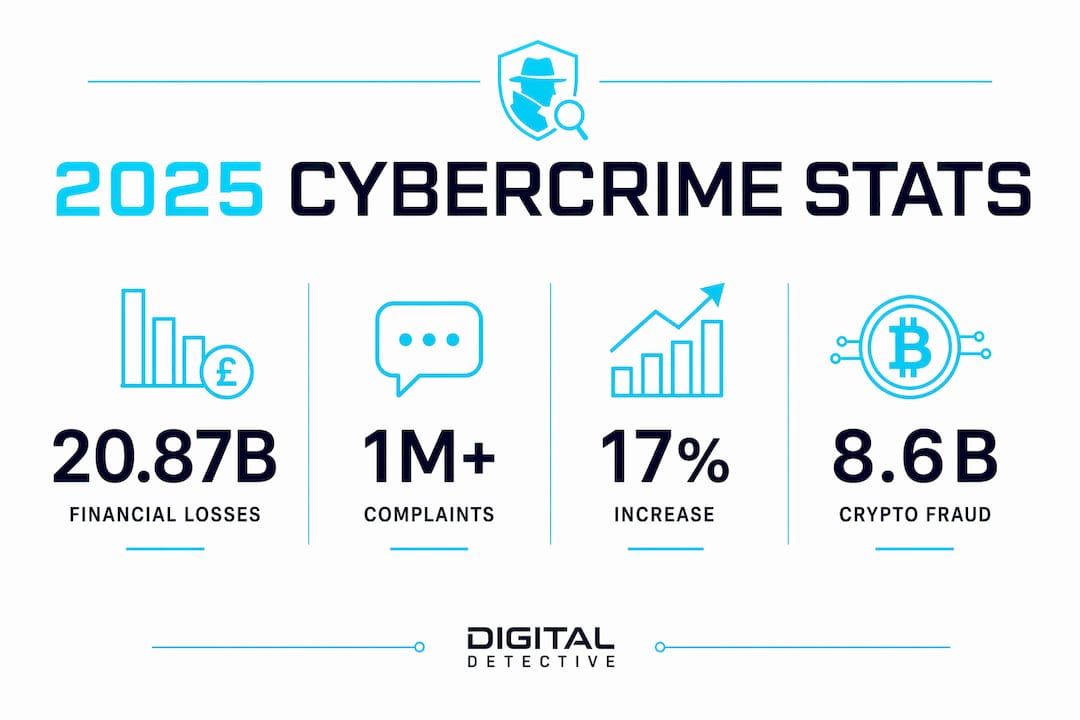
Cybercrime in 2025 is defined by the merger of AI-driven automation, identity theft, and infrastructure exploitation into a single, compressed attack chain that moves faster than most organisations can detect. The FBI recorded record $20.87 billion in cybercrime losses last year, with complaints surpassing one million for the first time. For cybersecurity professionals, law enforcement, and IT managers, the cybercrime trends 2025 data tells a clear story: attackers are no longer running isolated campaigns. They are running integrated operations that combine credential theft, malware deployment, and live infrastructure abuse in one fluid sequence.
What are the most significant cybercrime tactics in 2025?
The dominant attack methods of 2025 share one characteristic: speed. Attackers are compressing the time between initial access and full compromise to hours, not days. Understanding which techniques drive this acceleration is the first step in building a credible defence.
The most prevalent tactics this year include:
- AI-enhanced phishing: Generative AI produces grammatically flawless, contextually convincing lures at scale. Campaigns targeting e-commerce account for 14.17% of phishing volume, while digital services attract 16.15%, according to Kaspersky’s Financial Threat Report.
- Infostealer malware: Infostealer detections rose 59% globally on PCs in 2025. These tools harvest saved passwords, session cookies, and autofill data silently, giving attackers authenticated access without triggering login alerts.
- Ransomware: Ransomware activity increased 53% in 2025, with operational shifts towards double extortion and supply chain targeting.
- Social engineering and government impersonation: Investment fraud and impersonation scams remain persistent because they exploit human trust rather than technical vulnerabilities.
Ransomware operators in 2025 are not simply encrypting files and demanding payment. Many now exfiltrate data before encryption, then threaten public release to increase leverage. This dual pressure makes recovery far more complex for incident response teams.
Pro Tip: When triaging a suspected infostealer infection, prioritise session cookie invalidation across all authenticated services before resetting passwords. Stolen cookies bypass password resets entirely, so sequence matters.

How has the attack chain changed the cyber threat landscape?
Flashpoint analysts describe the 2025 threat environment as a unified attack chain that merges identity compromise, malware, and infrastructure exploitation into one continuous operation. This is the most significant structural shift in the emerging cyber threats picture.

Previously, defenders could treat credential theft, malware deployment, and lateral movement as separate phases with detectable gaps between them. That separation is gone. Attackers now purchase stolen session cookies from dark web markets, log in as authenticated users, and begin lateral movement within the same session. Multi-factor authentication offers no protection at this stage because the session is already validated.
The table below illustrates how the attack lifecycle has changed between 2023 and 2025:
| Attack Phase | 2023 Approach | 2025 Approach |
|---|---|---|
| Initial Access | Phishing for credentials | Purchasing live session cookies |
| Authentication Bypass | Credential stuffing | Session hijacking, bypassing MFA |
| Lateral Movement | Manual reconnaissance | Automated, AI-assisted scanning |
| Persistence | Backdoor installation | Abuse of legitimate cloud services |
| Detection Window | Days to weeks | Hours to minutes |
The implication for security operations centres is direct: signature-based detection and perimeter monitoring are insufficient. Defenders must monitor for anomalous authenticated behaviour, not just failed login attempts. Tools like Microsoft Sentinel, Splunk, and CrowdStrike Falcon now offer session anomaly detection specifically because the industry recognises this shift. Credential monitoring and active exploit readiness must be simultaneous priorities, not sequential ones.
What role did AI play in shaping cybercrime in 2025?
AI’s role in 2025 cybercrime is real but frequently overstated. The Alan Turing Institute’s research describes a “vibercrime” shift, where criminals use generative AI to automate low-level tasks such as writing phishing emails, generating malware code, and producing fraudulent documents. This lowers the skill barrier for entry-level criminals significantly.
The key limitations are worth noting for threat modellers:
- Model guardrails restrict capability: Most commercial AI models refuse to generate functional exploit code directly. Criminals work around this through prompt injection and fine-tuned open-source models, but the workarounds add friction.
- Technical debt accumulates: AI-generated malware requires human error correction. This creates identifiable forensic patterns in AI-generated attacks that experienced analysts can exploit during post-incident investigation.
- Fully autonomous attacks remain rare: AI-driven autonomous malware at scale is still constrained by guardrails and operational complexity. Human operators remain in the loop for high-value targets.
The forensic implication here is genuinely useful. Because AI-generated code carries predictable error signatures and stylistic patterns, investigators can sometimes attribute attacks to specific toolkits or criminal groups even when the actors believe AI has anonymised their work. This is an area where digital forensics is developing faster than most practitioners realise.
Pro Tip: When analysing suspected AI-generated malware, look for repetitive variable naming conventions, inconsistent commenting styles, and structurally redundant functions. These are hallmarks of AI code generation with minimal human editing.
Which sectors are most affected by cybercrime in 2025?
The impact of cybercrime on businesses and individuals in 2025 is not evenly distributed. Certain sectors and target types absorb disproportionate losses, and understanding the distribution helps IT managers and law enforcement allocate resources accurately.
The five most affected areas, ranked by financial and operational impact, are:
- Investment and cryptocurrency fraud: Investment fraud losses exceeded $8.6 billion in 2025, with over $7.2 billion linked to cryptocurrency schemes. This is the single costliest cybercrime category by a significant margin.
- E-commerce and digital services: Phishing campaigns specifically target these sectors, exploiting high transaction volumes and consumer trust in familiar brand interfaces.
- Critical infrastructure: Supply chain attacks against utilities, healthcare, and logistics providers increased in frequency, with ransomware operators prioritising targets where downtime creates maximum pressure.
- Government impersonation targets: Government impersonation scams surged 128% between 2023 and 2025, rising from 14,190 reports to 32,424. Many of these scams target employees on personal devices, bypassing enterprise monitoring entirely.
- Small and medium enterprises: SMEs lack the security operations capacity of large organisations but hold valuable data, making them attractive targets for ransomware and business email compromise.
The government impersonation figure deserves particular attention from law enforcement. Because these scams target personal devices rather than corporate systems, they fall outside standard enterprise security monitoring. The true scale of losses is almost certainly higher than reported figures suggest, as victims often do not connect personal fraud to a workplace security event.
| Sector | Primary Threat | Key Risk Factor |
|---|---|---|
| Financial services | Infostealer, investment fraud | High-value credentials |
| E-commerce | Phishing, session hijacking | Volume of transactions |
| Critical infrastructure | Ransomware, supply chain | Operational downtime pressure |
| Government and public sector | Impersonation scams | Personal device exposure |
| SMEs | Business email compromise | Limited security resources |
For IT managers overseeing mixed device environments, the personal device gap is a genuine blind spot. Bring-your-own-device policies without mobile device management create exactly the unmonitored surface that government impersonation scams exploit. Reviewing cybersecurity best practices for device policy is not optional at this threat level.
Key takeaways
The defining reality of 2025 cybercrime is that identity compromise, malware, and infrastructure exploitation now operate as a single accelerated chain, not as separate threats requiring separate defences.
| Point | Details |
|---|---|
| Record financial losses | FBI recorded $20.87 billion in losses with over one million complaints filed in 2025. |
| Infostealer surge | A 59% rise in infostealer detections means session cookie theft now bypasses MFA at scale. |
| Compressed attack chain | Attackers move from initial access to lateral movement within hours using stolen authenticated sessions. |
| AI role is real but limited | Generative AI automates low-level tasks but creates forensic patterns that investigators can exploit. |
| Investment fraud dominates | Cryptocurrency schemes account for over $7.2 billion of total losses, the largest single category. |
The uncomfortable truth about 2025’s threat picture
From where Computerforensicslab sits, working across criminal investigations, corporate breaches, and legal cases, the most striking thing about 2025’s cybercrime trends is not the sophistication of the attacks. It is how many organisations are still failing at the basics.
Multi-factor authentication remains inconsistently deployed. Identity and access management is treated as an IT administration task rather than a frontline security control. And yet, common security failures in these fundamentals are what attackers are actively exploiting. The compressed attack chain that Flashpoint describes is only possible because the entry points are still wide open.
The AI conversation is important, but it risks distracting practitioners from the more immediate problem. Criminals are not primarily winning because they have better AI. They are winning because defenders are monitoring the wrong signals. Watching for failed logins while attackers are already authenticated is a fundamental mismatch in detection logic.
For forensic investigators, the AI-generated attack pattern is genuinely promising territory. The technical debt in AI-generated code leaves traces that traditional human-written malware often does not. Attribution is becoming more tractable, not less, in certain attack categories. That is a counterintuitive finding that deserves more attention in the practitioner community. You can read more about how these trends intersect with forensic practice in our overview of digital forensics trends.
— Computerforensicslab
How Computerforensicslab supports cybercrime investigations
The cybercrime trends of 2025 demand forensic capability that keeps pace with attacker speed. Computerforensicslab provides professional digital forensics services to legal professionals, law enforcement, and corporate clients across the UK, covering malware analysis, credential theft investigations, and digital evidence collection for litigation. Whether you are responding to a ransomware incident, investigating suspected insider fraud, or building a legal case around a data breach, Computerforensicslab’s forensic analysts can recover, preserve, and analyse digital evidence to the standard required by UK courts. Our work spans computing devices, mobile phones, cloud platforms, and social media, with full chain of custody documentation and expert witness reporting. Contact Computerforensicslab to discuss your investigation requirements.
FAQ
What were total cybercrime losses in 2025?
The FBI recorded $20.87 billion in total cybercrime losses in 2025, with complaints rising 17% to over one million. This is the highest figure ever recorded by the FBI’s Internet Crime Complaint Centre.
How do infostealers bypass multi-factor authentication?
Infostealers harvest active session cookies from infected devices. Attackers use these cookies to authenticate as the victim without entering credentials, meaning MFA prompts are never triggered.
Which cybercrime type caused the most financial damage in 2025?
Investment fraud, predominantly cryptocurrency schemes, caused over $8.6 billion in losses. This made it the single most costly cybercrime category reported to the FBI in 2025.
Are ai-generated cyberattacks harder to investigate forensically?
Not necessarily. AI-generated malware carries identifiable error patterns and stylistic signatures from automated code generation. These forensic traces can aid attribution in ways that manually written malware sometimes does not.
How can organisations defend against the compressed attack chain?
Organisations must monitor for anomalous authenticated behaviour, not just failed logins. Deploying session anomaly detection tools, enforcing identity and access management policies, and conducting regular cybercrime investigation steps reviews are the most direct countermeasures.