Automated penetration testing uses software, scripts and increasingly autonomous agents to find and validate routine, checkable vulnerabilities on a continuous basis. It complements rather than replaces manual testing, which remains essential for business logic flaws and creative exploitation. Security teams should adopt a hybrid model and verify a vendor’s governance controls, including kill switches and scope enforcement, before any production run.
TL;DR:
- Automated tools efficiently scan large systems for known vulnerabilities and misconfigurations but cannot reliably assess business logic flaws or creative exploits.
- Most automation follows phases such as asset discovery, vulnerability scanning, exploit validation, and reporting, requiring human review before remediation.
- Advanced autonomous agents offer flexible attack simulations but generate noisy traffic and depend heavily on human oversight for accurate exploitation recognition.
- Hybrid testing, combining continuous automated scans with scheduled manual assessments, provides the most comprehensive security approach for evolving and complex environments.
- Firms should rigorously evaluate vendor controls, including kill switches and scope enforcement, before deploying autonomous testing in production environments.
Table of Contents
- What automated penetration testing is and where it applies
- How automated penetration testing works: the phased anatomy
- Types of automated approaches and tools available today
- Benefits and limitations: the practical trade-offs
- Integrating automation with manual testing: hybrid patterns and PTaaS
- Governance and vendor evaluation: APTS, MITRE mapping and tier guidance
- Implementation checklist and best practices for pilots and production
- Where forensic-grade evidence handling meets automated testing
- Our view on where automation sits in 2026
- How we can help you verify and apply automated testing results
- FAQ
- Sources
What automated penetration testing is and where it applies
Automated penetration testing refers to the use of software tools, including scanners, breach-and-attack simulation platforms and autonomous agents, to probe systems for exploitable weaknesses without a human operator driving every step. The primary goal is coverage at scale: running the same checks repeatedly across a large estate, on a schedule that no human team could sustain unaided.
Within that broad label sit several distinct activities, and the differences matter for procurement and risk decisions:
- Scanning identifies known vulnerability signatures and misconfigurations across hosts, applications and cloud assets.
- Runtime validation confirms whether a detected weakness is genuinely exploitable in the running application, not just theoretically present.
- Autonomous agents plan and execute multi-step attack chains with limited human steering, adapting their approach as they discover new information.
What automation does not replace is equally important. It does not reliably assess business logic flaws, such as a workflow that lets a user skip a payment step. It struggles with creative, context-aware exploitation that depends on understanding how a specific organisation actually operates. NIST penetration testing guidance recommends combining multiple testing techniques and validating vulnerability existence through varied methods rather than relying on any single approach, which is precisely the argument for keeping skilled testers in the loop. Automation also carries no authority to sign off compliance attestations; that remains a human and organisational responsibility. For a fuller picture of why manual testing retains this role, see the role of penetration testing in cybersecurity.
How automated penetration testing works: the phased anatomy
Most automated platforms follow a recognisable sequence, even when the underlying engine is a conventional scanner or an autonomous agent. Understanding the phases helps practitioners judge what output to expect, and where a human review gate belongs.
- Reconnaissance and asset discovery. Tools enumerate subdomains, open ports, exposed services and runtime endpoints, building a map of the attack surface before any probing begins.
- Vulnerability scanning and heuristic detection. Signature-based checks catch known issues, while behavioural heuristics flag anomalies that do not match a known pattern but still warrant investigation.
- Exploit attempts and exploitability validation. Safe, staged attempts confirm whether a flagged weakness can actually be leveraged, with impact deliberately limited to avoid disrupting production systems.
- Reporting, triage and remediation verification. Findings are collected as evidence, prioritised by exploitability and business impact, then re-tested once a fix is deployed to confirm closure.
Pro Tip: Treat phase three output as a hypothesis, not a verdict: route every “confirmed exploitable” finding through a brief human review before it reaches a remediation ticket.
Each phase produces artefacts a practitioner can audit later, which matters for both security operations and any subsequent forensic or legal use. A practitioner-level breakdown of these phases, including how evidence should be handled to remain defensible, appears in our penetration testing process guide. Teams building compliance reporting around these outputs often need a way to surface findings consistently across departments; a custom compliance dashboard build guide offers a practical starting point for structuring that reporting layer.
Types of automated approaches and tools available today
Choosing the right category of tool depends on what a team is trying to achieve, and on how much risk it can tolerate from an automated process touching live systems.
- DAST and classic scanners run broad, signature-driven sweeps across web applications and APIs, well suited to catching known vulnerability classes at scale.
- Breach and attack simulation (BAS) and adversary emulation tools replay known attacker techniques to test whether existing defences actually detect and block them.
- Runtime instrumentation and agent-based validation sit inside the running application, confirming exploitability in context rather than inferring it from external responses.
- Autonomous or AI-driven agents plan and adapt their own attack sequences, offering novel coverage but raising distinct governance questions.
MITRE’s CALDERA project demonstrates automated adversary emulation mapped against the ATT&CK framework and shows how automation reduces the routine resource burden of repeated posture assessments, freeing testers for more complex scenarios. Runtime instrumentation deserves particular attention here: Contrast Security’s guide to automated penetration testing describes how validating exploitability in context can materially cut false-positive rates compared with signature-only scanning, which improves developer trust in the findings they receive.
Benefits and limitations: the practical trade-offs
Automation earns its place through frequency and scale that manual testing cannot match on its own. A scanning platform can run nightly against a continuously deployed application, catching regressions within hours rather than waiting for the next scheduled engagement. Cost per scan falls sharply once a pipeline is configured, and coverage stays consistent because the same checks run the same way every time.
- Benefits: continuous coverage, lower marginal cost per run, consistency across repeated tests.
- Limitations: false positives and false negatives, inability to reason about business logic, noisy probing that can trip detection systems unintentionally.
- Operational risks: unthrottled scans against production can cause outages or alert fatigue if not staged carefully.
Experimental LLM-based offensive agents can complete a range of tasks but remain noisy, resource-intensive and inconsistent at recognising successful exploitation without explicit success signals, according to OWASP’s CTI and Cybench LLM experiments, a finding that argues directly for augmentation over replacement. That same research notes naive deployments of such agents often generate traffic patterns conspicuous enough to trigger detection controls, which is itself a mitigation lesson: throttle, stage in non-production environments first and keep a human verifying any high-impact finding before it reaches remediation.
Integrating automation with manual testing: hybrid patterns and PTaaS
The practical question for most security teams is not whether to automate, but where automation belongs in the testing calendar. A simple matrix helps:
- High-change applications and CI/CD pipelines suit automated baseline scanning run on every build or nightly.
- Complex business logic and compliance-driven engagements still need scheduled manual deep-dives by skilled testers.
- Hybrid patterns combine both: an automated baseline runs continuously, while a manual assessment runs quarterly or after major releases to probe what automation cannot reach.
- Penetration Testing as a Service (PTaaS) packages this hybrid approach as a managed offering, blending automated scanning with periodic human-led testing and a shared reporting dashboard.
Findings from either stream should route into the same triage and remediation workflow, so a vulnerability found by a scanner and one found by a human tester are prioritised on the same criteria rather than treated as separate categories of risk. Our standards-based methodology for penetration testing sets out how that routing can work in practice, including how evidence from both automated and manual streams should be preserved for later audit or legal use.
Governance and vendor evaluation: APTS, MITRE mapping and tier guidance
Governance is where automated testing most often goes wrong, not because the tools are unreliable, but because teams deploy them without the controls that keep an autonomous process inside its intended scope. The OWASP Autonomous Penetration Testing Standard (APTS) defines 173 tier-required requirements across eight governance domains, covering safety, transparency and auditability for systems that make independent decisions during a test. The APTS foreword highlights that autonomous agents introduce governance gaps, such as scope enforcement and resistance to manipulation, that conventional scanners never needed to address.
Before any production deployment, security leaders should:
- Request a live demonstration of the vendor’s kill switch and scope enforcement, not a slide describing them.
- Map proposed test techniques against MITRE ATT&CK via tools such as CALDERA, so findings translate into detection coverage conversations.
- Run Customer Acceptance Testing (CAT) for high-assurance deployments, following the APTS vendor evaluation guide, which also recommends tamper-proof audit trails as a baseline expectation.
Pro Tip: Ask every automation vendor which APTS tier their product meets, and treat a vague answer as a red flag, not a technicality.
Implementation checklist and best practices for pilots and production
A disciplined rollout separates teams that gain real coverage from those that inherit outages or false confidence. The sequence below reflects how the governance principles above translate into a working pilot.
- Draft a machine-readable rule of engagement (RoE) that scopes targets precisely and leaves no ambiguity for an autonomous agent to exploit.
- Run the first cycles in staging, never against production, to observe behaviour before granting broader access.
- Verify the kill switch and rate limits live, during a vendor demo, rather than accepting documentation alone.
- Conduct Customer Acceptance Testing where the deployment touches sensitive or regulated systems.
- Integrate findings into existing CI/CD and ticketing workflows, with a human verification gate for any finding flagged as high impact.
- Retain auditable logs and evidence suitable for compliance review and, where relevant, forensic reconstruction later.
| Pilot stage | Primary control | Who verifies it |
|---|---|---|
| Scoping | Machine-readable RoE | Security lead |
| Staging run | Kill switch and rate limits | Vendor demo, witnessed |
| Production rollout | Human verification gate on high-impact findings | Triage team |
| Ongoing operation | Tamper-proof audit trail | Compliance or audit function |
Where forensic-grade evidence handling meets automated testing
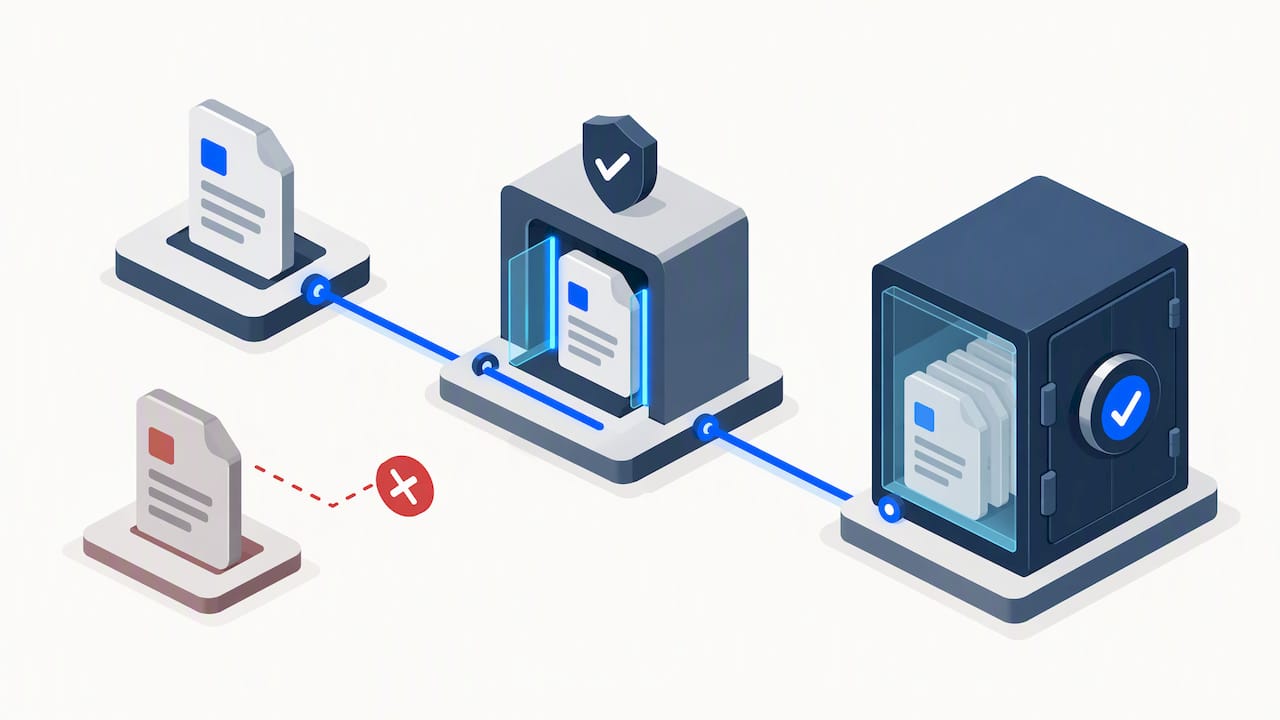
Investigators often examine how automated findings were generated, logged and validated when that evidence later matters in litigation or disciplinary proceedings. Chain-of-custody discipline and the ability to produce an expert witness report both depend on the audit trails being genuinely tamper-proof, not merely described as such in vendor documentation. Where a pentest finding becomes part of a wider investigation, the handling has to meet the same standard as any other digital evidence.

Our view on where automation sits in 2026
Automation is an enabling capability, not a replacement for skilled testers, and treating it as the latter is the most common mistake we see. The evidence on autonomous agents, noisy, inconsistent at recognising genuine exploitation, still dependent on human oversight, supports that reading rather than the more breathless vendor claims circulating in the market. We recommend piloting with a live vendor demonstration and Customer Acceptance Testing before granting any automated tool broader access.
— Computer
How we can help you verify and apply automated testing results
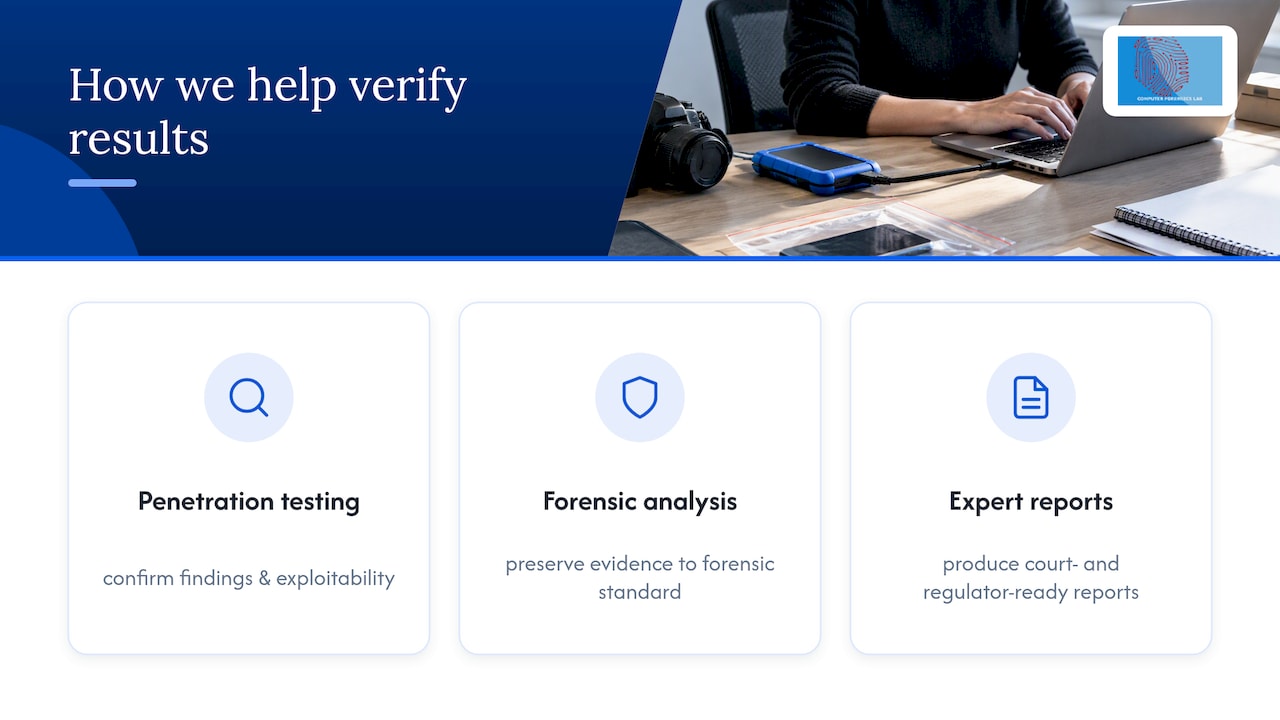
When an automated test throws up a finding that matters, whether for a security review, a disciplinary matter or potential litigation, penetration testing, forensic analysis and expert witness reporting that stands up to scrutiny can be provided. Services are available to help teams verify exploitability claims, preserve evidence to a forensically sound standard and produce reports suitable for court or regulatory review. For organisations piloting automation and wanting an independent check on the results, our digital forensics services are the place to start a conversation.
FAQ
What is automated penetration testing?
Automated penetration testing uses software tools, including scanners and increasingly autonomous agents, to find and validate exploitable weaknesses in systems without a human driving every step. It works best for routine, checkable vulnerabilities and continuous coverage, while complex or creative exploitation still needs skilled human testers.
How difficult is penetration testing to automate fully?
Fully automating penetration testing remains difficult because business logic flaws and context-aware exploitation resist signature-based or purely algorithmic approaches. NIST guidance recommends combining multiple testing techniques precisely because no single automated method reliably validates every class of vulnerability.
Is penetration testing being replaced by AI?
No credible evidence supports full replacement. Research on LLM-based offensive agents shows they can automate many tasks but remain noisy, resource-intensive and inconsistent at recognising successful exploitation, which points to augmentation rather than replacement of skilled testers.
Can you automate penetration testing end to end?
Parts of the process, reconnaissance, scanning and exploitability validation, can run largely unattended once properly scoped. Reporting, business logic review and final sign-off still require human judgement, which is why a hybrid model combining automated baselines with scheduled manual testing remains the practical standard.
Sources
- OWASP Autonomous Penetration Testing Standard (APTS)
- MITRE CALDERA (CALDERA®)
- NIST penetration testing guidance
- OWASP CTI / Cybench LLM experiments
- Contrast Security: automated penetration testing guide