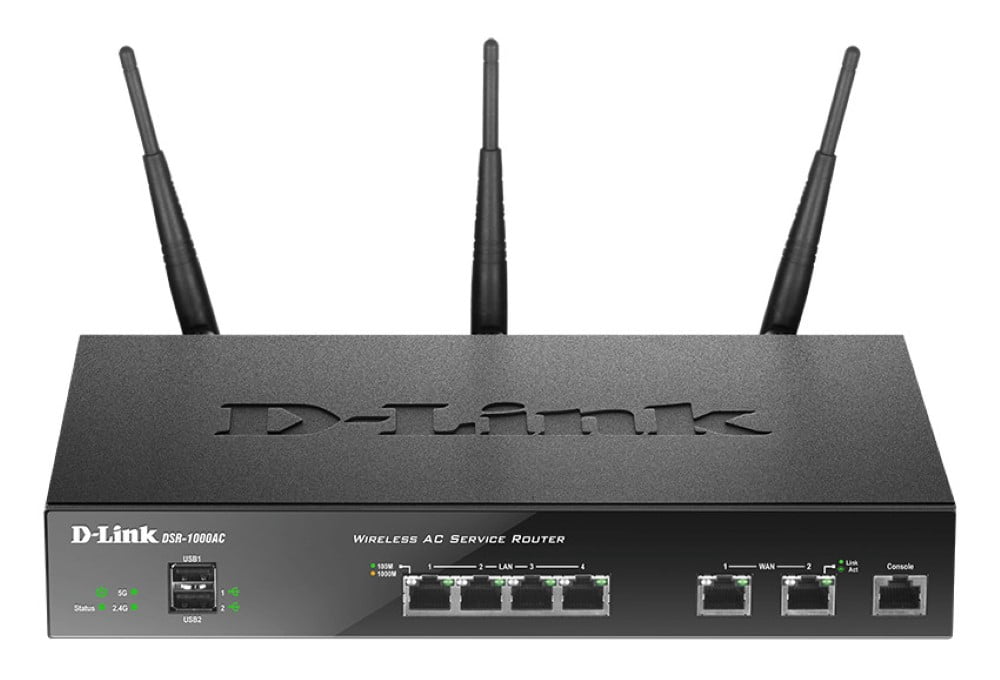
D-Link DSR-1000AC IEEE 802.11ac Ethernet Wireless Router - 2.40 GHz ISM Band - 5 GHz UNII Band - 6.75 MB/s Wireless Speed
☆☆☆☆☆
reviews
US$243.24
Price when purchased online
Free shipping
Free 30-day returns
We aim to show you accurate product information. Manufacturers, suppliers and others provide what you see here.
Product details
| Management number | 255523078 | Release Date | 2026/11/21 | List Price | US$243.24 | Model Number | 255523078 | ||
|---|---|---|---|---|---|---|---|---|---|
| Category | |||||||||
Wireless VPN Router, 2 GE WAN, 4 GE LAN, 802.11ac
- Comprehensive Management Capabilities The DSR-500/500AC and DSR-1000/1000AC Unified Services Routers include dual WAN Gigabit Ethernet ports to provide high availability for your WAN or Internet connections. Traffic can be load-balanced across the links with Outbound Load Balancing, increasing the performance and availability of business applications. The secondary WAN port can also be used to create a DMZ, isolating servers from your LAN. The DSR series supports mobile broadband networks via an extendable USB modem*, such as 3G or 4G** dongles. Traffic load balancing can be performed on the mobile data connections, providing an additional layer of redundancy for critical or backup applications.
- Web Authentication Capabilities Captive Portal allows employees and guest users to be easily authenticated and authorized by accessing a customized landing page. Users can be authenticated by a local database, RADIUS, LDAP, Microsoft Windows Active Directory, NT Domain and POP3 server. A maximum of four servers can be configured at any one time.
- Complete and Robust VPN Features Web Content Filtering A fully featured virtual private network (VPN) provides your mobile workers The DSR series also and branch offices with a secure link to your network. The DSR series routers administrators are capable of Generic web content filtering Routing Encapsulation (GRE) tunnels, empowering your mobile users by ActiveX, and cookies, or to providing remote access to a central corporate database. Site-to-site VPN filtering, which tunnels use IP Security (IPSec) Protocol, Point-to-Point Tunneling Protocol content from a list (PPTP), or Layer 2 Tunneling Protocol (L2TP) to facilitate branch office URLs and real-time connectivity through encrypted virtual links.
- Web Content Filtering The DSR series also provides a web content filtering feature to help administrators monitor, manage and control employees? Internet usage. Static web content filtering helps to remove malicious objects such as Java applets, ActiveX, and cookies, or to block URLs by keyword. Dynamic web content filtering, which requires a license subscription, allows administrators to filter content from a list of categories. Multiple global index servers, with millions of URLs and real-time website data, enhance performance and maximize service availability.
- General features: Ethernet Interface 2 10/100/1000 Mbps WAN Ports 4 10/100/1000 Mbps LAN Port Wireless Interface 802.11 ac/a/b/g/n (Concurrent dual band) 3 Detachable 2 dBi Omni-Directional Antennas USB 2.0 2 USB 2.0 ports Console port RJ-45 Performance*** Firewall Throughput**** 950 Mbps VPN Throughput***** 250 Mbps Concurrent Sessions 100 000 New Sessions (per second) 1000 Firewall Policies 600 Internet Connection Type Static/Dynamic IP PPPoE/L2TP/PPTP Multiple PPPoE Firewall System Static Route Dynamic Route: RIP v1/v2, OSPF, OSPFv3 Dynamic DNS Inter-VLAN Route NAT, PAT Web Content Filtering: Static URL, Keywords, Dynamic WCF (License is required) Intrusion Prevention System (IPS): Signature Package Included in Firmware Authentication: Internal User Database, Radius, POP3, LDAP, AD, NT Domain Networking DHCP Server/Client DHCP Relay IEEE 802.11q VLAN VLAN (port-based) IP Multicast: IGMP Proxy, IGMP Snooping IPv6 Route Failover Outbound Load Balancing 3G/4G** Redundancy Virtual Private Network (VPN) VPN Tunnels: 155 IPSec Tunnels: 70 PPTP/L2TP Tunnels: 25 GRE Tunnels: 20 Encryption Methods: DES, NULL IPSec/PPTP/L2TP Server IPSec NAT Trraversal Dead Peer Detection IP Encapsulating Security Payload (ESP) IP Authentication Header (AH) VPN Tunnel Keep Alive Hub and Spoke Bandwidth Management Maximum Bandwidth Control Priority Bandwidth Control: - Port-based QoS - 3 Classes System Management Web-based User Interface Command Line SNMP v1, v2c, v3
- Wireless Security Wired Equivalent Privacy (WEP) Wi-Fi Protected Setup (WPS) Wi-Fi Protected Access ??? Personal (WPA-PSK) Wi-Fi Protected Access ??? Enterprise (WPA-EAP) Wi-Fi Protected Access ???µ???????? 2 ??? Personal (WPA-PSK) Wi-Fi Protected Access ???µ???????? 2 ??? Enterprise (WPA-EAP) Multiple Service Set Identifier (SSID) Service Set Identifier (SSID) to VLAN Mapping Wireless Frequency 802.11b/g/n: 24 GHz to 2.483 GHz 802.11a/n/ac: 5.18 GHz to 5.825 GHz Wireless speed IEEE 802.11a: 6, 9, 12, 18, 24, 36, 48 and 54 Mbit/s IEEE 802.11b: 1, 2, 5.5 and 11 Mbit/s IEEE 802.11g: 6, 9, 12, 18, 24, 36, 48 and 54 Mbit/s IEEE 802.11n (2.4 GHz): 6.5 ~ 300 Mbit/s IEEE 802.11n (5 GHz): 6.5 ~ 150 Mbit/s IEEE 802.11ac: 7.2 ~ 1300 Mbit/s Transmitter Output Power****** IEEE 802.11a: 15 dBm at 6~54 Mbit/s IEEE 802.11b: 20 dBm at 1~11 Mbit/s IEEE 802.11g: 14 dBm at 6~54 Mbit/s IEEE 802.11n: 14 dBm at 6~300 Mbit/s (2.4 GHz) 15 dBm at 6~150 Mbit/s (5 GHz) IEEE 802.11ac: 12 dBm at 7.2~1300 Mbit/s Receiver Sensitivity IEEE 802.11a: -82 dBm at 6 Mbit/s -81 dBm at 9 Mbit/s -79 dBm at 12 Mbit/s -77 dBm at 18 Mbit/s -74 dBm at 24 Mbit/s -70 dBm at 36 Mbit/s -66 dBm at 48 Mbit/s -65 dBm at 54 Mbit/s IEEE 802.11b: -89 dBm at 2 Mbit/s -83 dBm at 11 Mbit/s IEEE 802.11g: -82 dBm at 6 Mbit/s -81 dBm at 9 Mbit/s -79 dBm at 12 Mbit/s -77 dBm at 18 Mbit/s -74 dBm at 24 Mbit/s -70 dBm at 36 Mbit/s -66 dBm at 48 Mbit/s -65 dBm at 54 Mbit/s IEEE 802.11n: 2.4 GHz/HT-20: -82 dBm at MCS0/8/16 -79 dBm at MCS1/9/17 -77 dBm at MCS2/10/18 -74 dBm at MCS3/11/19 -70 dBm at MCS4/12/20 -66 dBm at MCS5/13/21 -65 dBm at MCS6/14/22 -64 dBm at MCS7/15/23 2.4 GHz/HT-40: -79 dBm at MCS0/8/16 -76 dBm at MCS1/9/17 -74 dBm at MCS2/10/18 -71 dBm at MCS3/11/19 -67 dBm at MCS4/12/20 -63 dBm at MCS5/13/21 -62 dBm at MCS6/14/22 -61 dBm at MCS7/15/23 5 GHz/HT-20: -82 dBm at MCS0 -79 dBm at MCS1 -77 dBm at MCS2 -74 dBm at MCS3 -70 dBm at MCS4 -66 dBm at MCS5 -65 dBm at MCS6 -64 dBm at MCS7 5 GHz/HT-40: -79 dBm at MCS0 -76 dBm at MCS1 -74 dBm at MCS2 -71 dBm at MCS3 -67 dBm at MCS4 -63 dBm at MCS5 -62 dBm at MCS6 -61 dBm at MCS7 IEEE 802.11ac: VHT-20: -82 dBm at MCS0 -79 dBm at MCS1 -77 dBm at MCS2 -74 dBm at MCS3 -70 dBm at MCS4 -66 dBm at MCS5 -65 dBm at MCS6 -64 dBm at MCS7 -59 dBm at MCS8 -57 dBm at MCS9 VHT-40: -79 dBm at MCS0 -76 dBm at MCS1 -74 dBm at MCS2 -71 dBm at MCS3 -67 dBm at MCS4 -63 dBm at MCS5 -62 dBm at MCS6 -61 dBm at MCS7 -56 dBm at MCS8 -54 dBm at MCS9 VHT-80: -76 dBm at MCS0 -73 dBm at MCS1 -71 dBm at MCS2 -68 dBm at MCS3 -64 dBm at MCS4 -60 dBm at MCS5 -59 dBm at MCS6 -58 dBm at MCS7 -53 dBm at MCS8 -51 dBm at MCS9
- Physical Parameters Power Supply External Power Supply Unit: DC 12 V/3 A Max. Power Consumption 23.1 W MTBF 360 000 hours Dimensions 180 x 280 x 44 mm Weight 1.728 kg with 3 antennas Temperature Operating: 0 to 40?°C Storage: -20 to 70?°C Humidity Operating: 5% to 95% non-condensing Certifications EMI FCC Class B CE Class B RCM IC VCCI Safety cUL LVD (EN60950-1) 3rd Party Certification IPv6 Ready Wi-Fi VPNC Basic Interop
| Router type | VPN Router |
|---|---|
| Brand | D-Link |
| Wireless performance | AC1300 |
| Number of wireless frequency bands | Dual-Band |
| Wireless | 802.11 ac/a/b/g/n |
| Interface type | Ethernet |
| Maximum download speed | 1300 Mbps |
| Transfer rate | 1300 Mbps |
| Number of ports | 4 |
| Frequency | 2.4 GHz |
| WiFi security | WEP, WPA-PSK, WPA-EAP |
| Accessories | <ul><li>D-Link DSR-1000AC</li><li>External power adapter</li></ul> |
| Inputs/Outputs | USB 2.0 |
| Model name | DSR-1000AC |
| In/Out type | Wireless |
| Number of antennas | 3 |
| Assembled product height | 1.7 in |
| Assembled product weight | 5.3 oz |
| Count | 1 |
Correction of product information
If you notice any omissions or errors in the product information on this page, please use the correction request form below.
Correction Request Form